
财务管理
What are Interchange Fees?
Interchange fees are transaction expenses that a merchant’s bank (the acquirer) pays to a customer’s bank (the issuer) whenever a customer uses a credit or debit card.
Through these costs, the issuing bank is compensated for specific transaction-related operations, including handling the transaction and associated fraud risks, as well as providing credit to the consumer.
Since these fees are passed from the banks to the merchant, they are included in the existing processing fees.
How are Interchange Fees Calculated?
It is important to note that interchange fees are not flat fees. In fact, these expenses are calculated using a complex formula. It includes a percentage of the payment volume, as well as a fixed item fee.
However, there are some elements that influence this formula:
- Card type: Some cards, like reward cards or corporate credit cards, have higher fees.
- Transaction type: Card-present payments are cheaper than card-not-present ones (online payments)
- 行业: Based on Merchant Category Codes (MCCs) established by card networks, some industries have lower fees than others.
- Data Quality: A lower rate category can be achieved if additional information, like the zipcode or invoice number, is provided during checkout.
What are Interchange Pricing Models?
Payment processors use three main types of interchange pricing models to bill SaaS companies for the fees associated with payments. Depending on the type of interchange pricing model a payment processor chooses, the SaaS business will obtain more or less transparency over the expenses.
|
定价模式 |
描述 |
最适合 |
|
Interchange Plus |
Passes the exact interchange cost through to you, plus a small, transparent markup. |
High-volume businesses seeking total transparency. |
|
固定费率 |
Charges a single fixed percentage regardless of the card type used by the customer. |
Small businesses with low or unpredictable volume. |
|
分层定价 |
Groups transactions into “Qualified,” “Mid-Qualified,” and “Non-Qualified” buckets. |
Often the most expensive and least transparent model. |
How Do Interchange Fees Work?
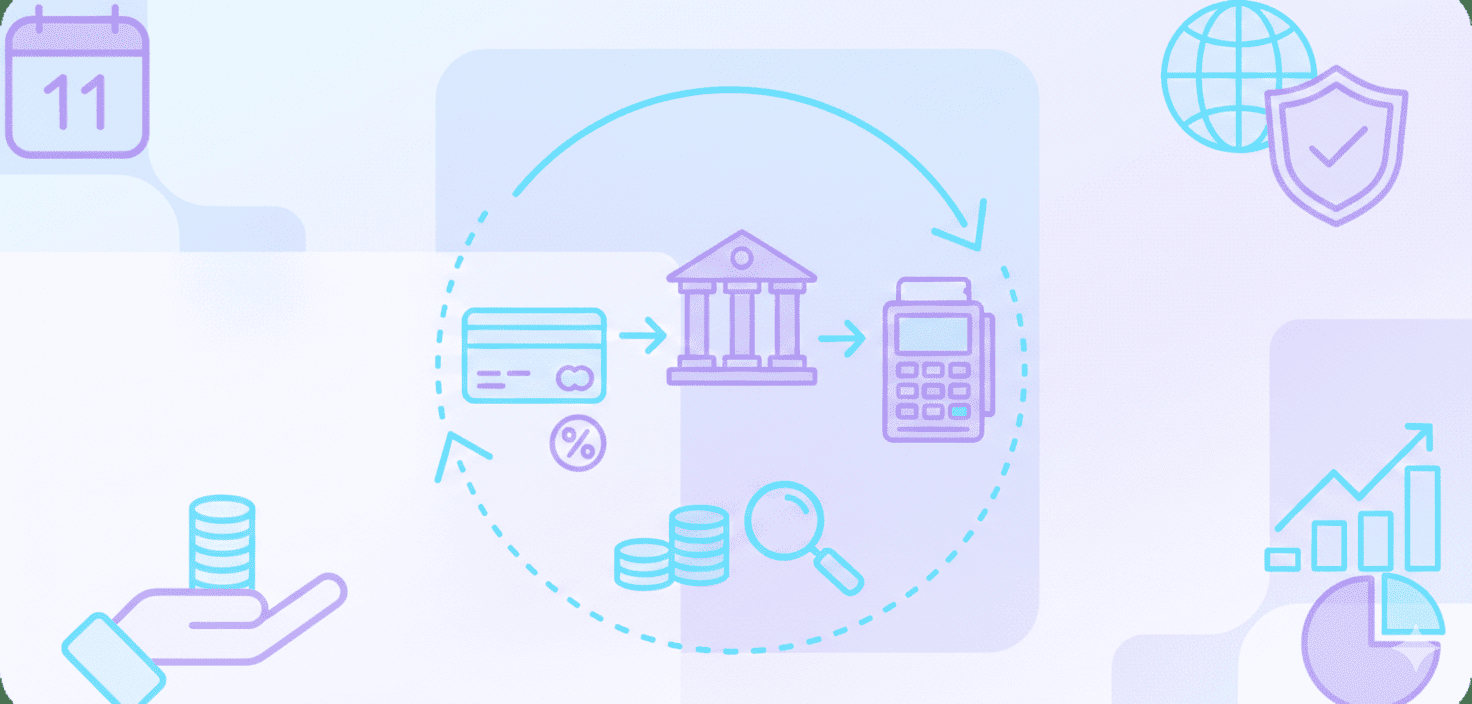
The process behind an interchange has the following steps:
1. The customer makes the card payment.
- The merchant’s terminal sends an authorization request through the card network to the issuing bank.
- Funds are verified by the issuing bank and the transaction is approved.
- Once the payment is settled, the issuing bank will calculate the interchange fees and deduct them from the funds before sending the remaining balance to the merchant’s bank. For example, if a customer spends $100 and the interchange fee is 2%, the merchant’s bank receives $98.
- The payment processor then takes their additional markup before the final amount hits the merchant’s business account.
How do Interchange Fees Affect Businesses?
Interchange fees can have a direct impact on profit margins.
They are non-negotiable and do not depend on the size of the business.
For example, a 2.5% fee can be manageable by an enterprise, but for a smaller, start-up company, it can be very high.
Whatever the costs, it is important that you are aware of them and collaborate with a payment partner that is transparent about this.
How Can SaaS Businesses Reduce Interchange Fees?
Interchange fees cannot be negotiated with Visa or Mastercard, but there are other optimizations SaaS businesses can make to lower expenses. These include:
- Address Verification(AVS): By implementing this process for online orders, businesses are reducing the fraud risk, which can lead to lower fees.
- Prompt 支付处理: Fees tend to go up for payments that have not been processed within 24 hours.
- Use Level 2 and Level 3 Data: B2B businesses can request tax IDs for corporate or government transactions, which can lower fees.
- 减少 Disputes: Receiving a high number of chargebacks can have a direct impact on your interchange fees.
结论
Interchange fees are part of digital commerce. It is important to be aware of these expenses, understand how they are calculated, and choose a pricing model that ensures transparency.

