
Customer Retention
What is SaaS Churn Prediction?
What is SaaS Churn Prediction?
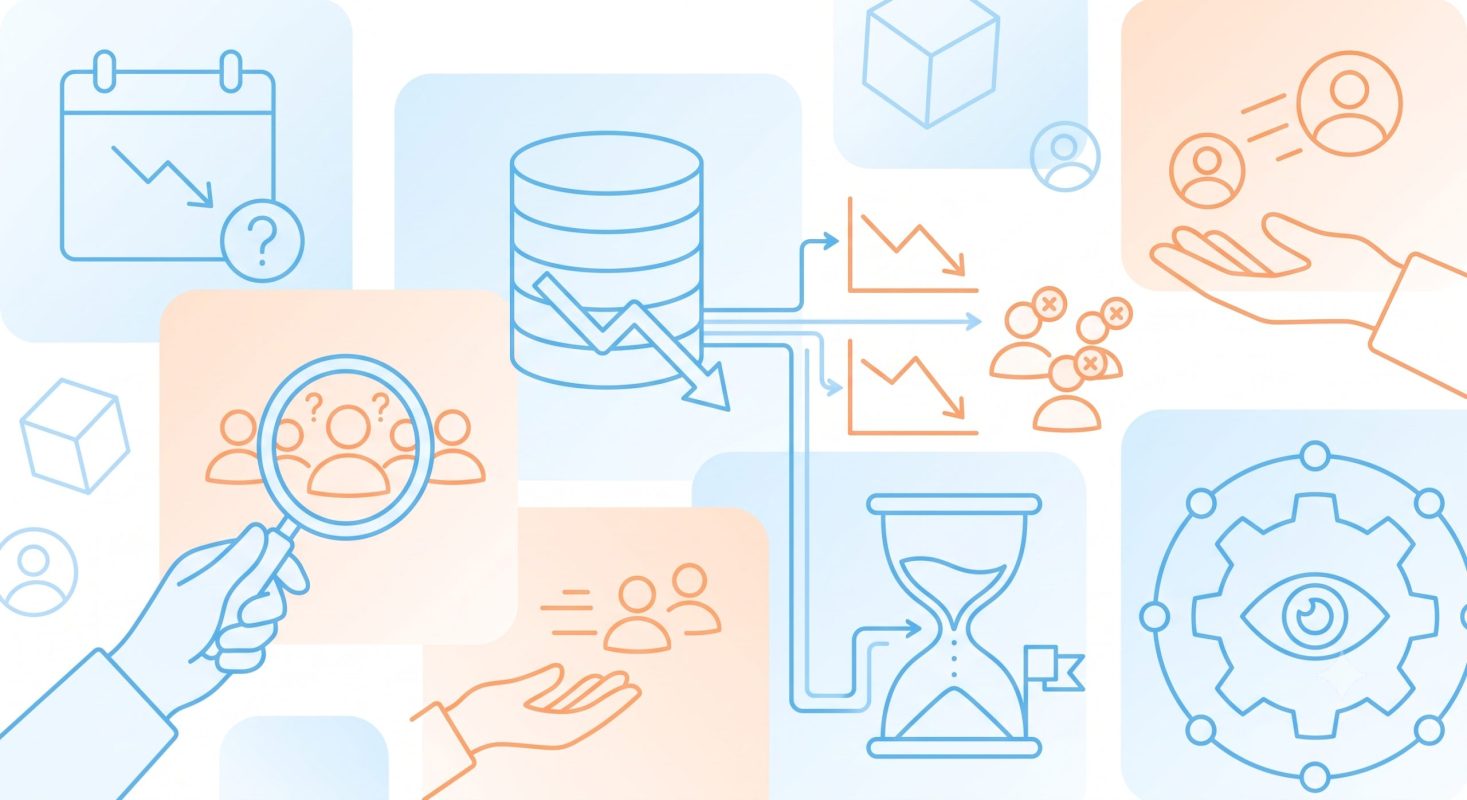
Churn prediction in SaaS is the analysis of customer behaviors to determine who may cancel or stop paying. Teams receive cancellation notices, often weeks or months in advance, which can provide information regarding accounts that may discontinue service.
For subscription companies, recurring revenue is a characteristic. Contract cessation is observed to relate to various factors beyond direct revenue reduction, including customer lifetime value, net revenue retention, and customer acquisition costs.
How does Churn Prediction differ from Churn Analysis and Churn Measurement?
The following three terms are often confused, although they have distinct meanings:
- SaaS Churn measurement predominantly involves past data. It is the calculation of loss, revenue, or logo churn at a given time, usually on a monthly or quarterly basis.
- SaaS Churn analysis aims at uncovering reasons for customers leaving. The study examines a specific group of churned customers to identify common factors that may have influenced their decision to depart, such as aspects of the onboarding stage, pricing structures, or support interactions.
- Churn prediction tries to forecast it. Using patterns uncovered through the analysis, it predicts the probability of churn among current customers, thereby prioritizing those most likely to leave.
In a sense, measurement is your way of seeing how big the problem is, analysis is your way of understanding why it happened, and prediction, with the use of the time element, is a way to find out who is going to be next and possibly avert the decision altogether.
What data prerequisites does a SaaS Churn Model need?
For any churn model, the quality of the data that powers it is essential. Usually, the most important categories of data include:
- Usage data: It includes login frequency, feature usage, seat activation, and session depth, which may reflect patterns associated with customer disengagement.
- Customer Success (CS) Data: Customer health scores, support ticket sentiment, QBR notes, CSAT, and NPS scores are all customer success data points.
- Billing Data: Payment failures, downgrade requests, invoice disputes, discount or credit history are all part of your billing record data for churn prediction.
- Contract Data: Contract type, renewal dates, contract terms, and history of expansion or seat count.
A combination of three sources is enough to make the churn prediction model’s performance significantly different from that of using only customer usage data, as disconnections may first manifest in customer service and billing data before appearing in the product.
Should you build or buy a SaaS Churn Prediction Model?
A custom stack, utilizing technologies such as dbt, Snowflake, and Python, can provide control over features, scoring logic, and product-model evolution. This pertains to companies whose products include complex features that may necessitate a different logical approach.
When platforms such as Gainsight, Vitally, Catalyst, Planhat, ChurnZero, or Custify are utilized, an initial system may achieve operational status in roughly two months. This influences the amount of manual configuration required for customer success processes, owing to their integrated functionalities.
|
Build |
Buy |
|
|
Time to value |
Months |
Weeks |
|
Customization |
High |
The scope of operation is defined by the platform’s model |
|
Continuous expenditure |
Engineering time |
Subscription fee |
|
For |
Complex, data-mature orgs |
Most mid-market SaaS teams |
How do you sync scores into the CS Workflow?
SaaS Churn score by itself has very limited utility; the really helpful feature is what is triggered as a result. The approach applies the model, pushing the score to the CSMs’ current system, limiting extensive new tasks in their daily activities. Actions related to risk-tier drops can be initiated by events such as dashboards changing, an outreach campaign launch, a task assignment, or an executive’s escalation. The clearer the cause-and-effect between “score has changed” and “action fires,” the more effectively the model reduces churn and the less it does a diagnostic.
What are the common churn prediction failure modes?
The ways that churn models break down are actually quite consistent:
- Label leakage trains a model using data points that precede a churn event, but also incorporate information from after the event (e.g., a ‘cancellation requested’ flag), which can result in a higher observed accuracy during testing without affecting real-world performance.
- The weekly integration cycle for daily-updating usage and billing information affects the recency of the model’s scores.
- Model score generation can play a role in addressing potential risks; however, there is no formalized obligation regarding a specific response.
- An increased number of clients flagged as ‘high risk’ may correspond with modifications in how CSMs address these alerts.
Making the decision: Do you need Churn Prediction?
Ask yourself:
- Is the identification of an account’s risk status typically observed following a cancellation inquiry?
- Do we have enough historical SaaS churn data — and enough live usage, CS, SaaS billing, and contract data — to train a reliable model?
- Upon receiving a risk score, what would the customer success team’s response be?
Decision factors to weigh:
- For statistical validation of a predictive model, the customer count and the volume of churn cases are considered, as a limited quantity of churn events can affect statistical reliability
- Budget of the team to construct and maintain a model compared to buying the platform
- The CS team’s capacity for deploying a playbook in response to new alerts
Conclusion
Churn prediction in SaaS is about making retention a proactive activity rather than something to review at the end of a month. The availability of a dataset, a complementary process, and a team designated for task execution allows churn prediction to assume a role in a subscription company’s approach to customer retention and revenue maintenance.
Ready to get started?


 English
  Español
  Português
  Português do Brasil
  Français
  Italiano
  Deutsch
  Nederlands
  Polski
  Română
  Українська
  简体中文
简体中文  日本語
日本語  한국어
한국어