
Paiements SaaS
What is an ACH Payment?
What is an ACH Payment?
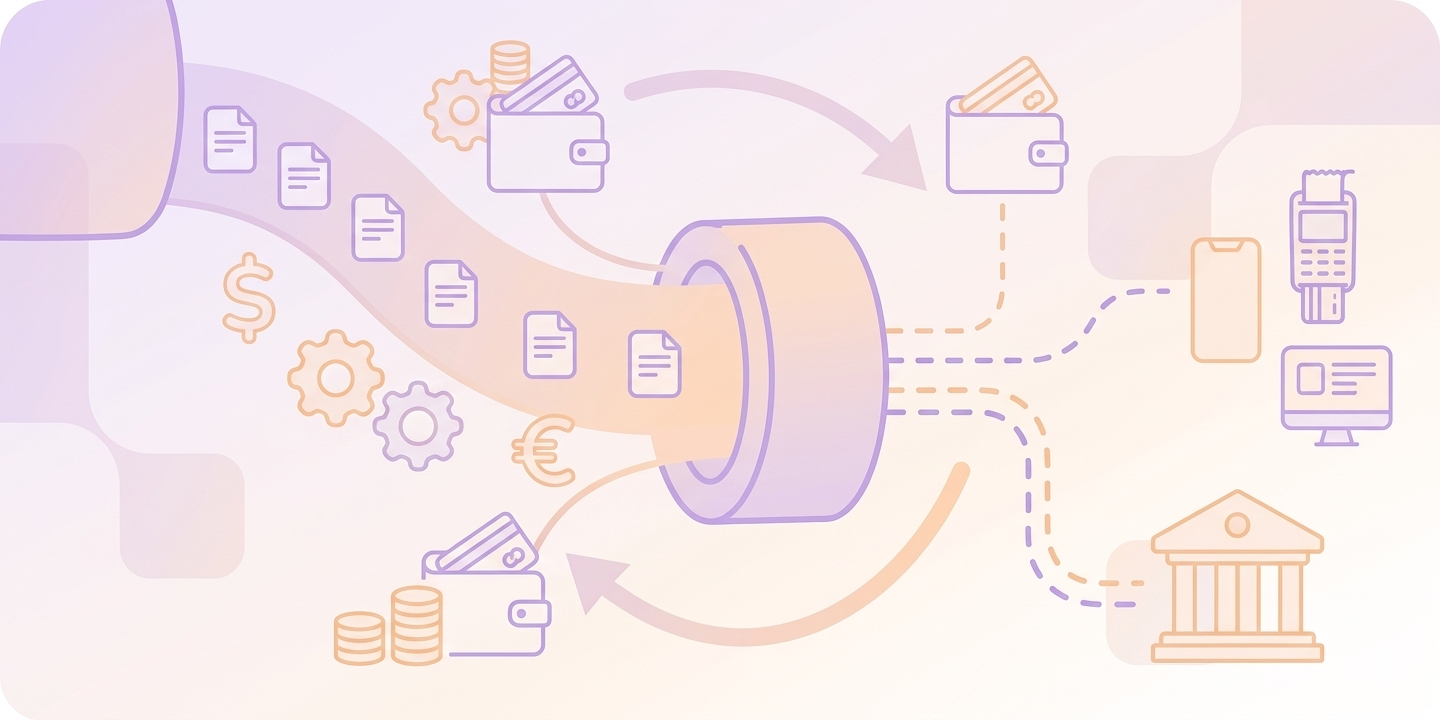
Automated Clearing House (ACH) is a major electronic network operating in the United States for transferring money. In contrast to wire transfers or credit card transactions, which are processed one at a time, ACH transactions are processed in batches throughout the business day.
- Autorisation: Customer provides their bank routing and account numbers to the SaaS platform and signs a digital mandate.
- Origination: The SaaS provider’s bank (ODFI) gathers these payment requests and sends them in a batch file to a clearing house.
- Clearing and Routing: The Federal Reserve or The Clearing House separates the entries and sends them to the customer’s bank (RDFI).
- Règlement: Bank confirms the availability of funds and settles the transfer within 1 to 3 business days.
How are ACH Transfers used in day-to-day operations?
ACH transfers are often used for the recurring revenue model common in SaaS businesses. They are primarily used to renew monthly or annual subscriptions for B2B clients.
Going a step further, these payment methods enable usage-based billing, which “zeroes in” on a customer’s usage and charges it to their bank account. The removal of manual invoicing could impact the speed of payments received by merchants on high-value contracts, enabling them to bypass the standard 3% credit card fee.
What are the key differences between an ACH Transfer and a Wire Transfer?
While both transfer money between financial institutions, they serve very different roles in a SaaS billing strategy.
|
Fonctionnalité |
ACH Transfer (SaaS Standard) |
Virement bancaire |
|
Cas d'utilisation principal |
Recurring subscriptions, payroll, B2B billing |
Large real estate closings, high-value one-time B2B |
|
Processing Style |
Batch-processed in groups throughout the day |
Individual processing in real-time |
|
Transfer Direction |
Bi-directional: Can “Push” or “Pull” funds |
Unidirectional: Primarily operates via a “Push” mechanism, initiated by the sender |
|
Average Cost |
$0.20 – $1.50 (Flat fee or capped low %) |
$15.00 – $50.00 (Per transaction) |
|
Transaction Limit |
Processor velocity frequently influences the maximum achievable performance |
High-value transfers are associated with a low number of restrictions |
|
Reversibility |
Dispute/return windows are subject to regulation |
The conventional understanding of transferred funds as final is a factor in retrieval attempts |
|
Geographic Reach |
Domestic (United States only) |
Global (via the SWIFT network) |
How does payment security compare between methods?
NACHA (National Automated Clearing House Association) operating rules govern ACH payments, which are often categorized as a relatively secure payment method. Because bank account numbers do not change often, they are less vulnerable to stolen or lost card types of fraude that banks must deal with daily.
- Durée: Observed differences in payment failure frequencies could be related to the contrasting expiration conventions for bank details and credit cards.
- Verification: Current SaaS products often utilize d'API to verify bank account ownership rapidly, potentially reducing instances of ‘unauthorized’ return codes.
- Reversibility: The fact that the business-to-business (B2B) contesting window is much shorter and stricter than that of consumer credit card rejets de débit means that both options have their pros and cons.
How do you choose the right payment method?
Whether to use ACH or other methods depends on the amount of money transacted, the type of customer, and the available time.
- Payment amounts exceeding $100 may correlate with increased ACH usage when compared to convenience options.
- The ACH system is often used in B2B relationships involving les paiements récurrents over an extended period.
- ACH transactions are primarily used within the U.S.; international customers may require consideration of payment alternatives like SEPA (Europe) or global wire transfers.
Make it a habit to continuously run a “pre-notification” system that sends out an email to customers 2–3 days before an ACH pull to make sure they have enough money in their accounts and thus prevent them from incurring expensive NSF (Non-Sufficient Funds) return fees.
Conclusion
SaaS ACH payment methods are a way to manage recurring revenue, which may impact economic factors and customer churn. The use of bank-to-bank transactions for high-ticket subscription items may influence software companies’ profit margins and billing efficiency.
Prêt à commencer ?


 Français
  English
  Español
  Português
  Português do Brasil
  Italiano
  Deutsch
  Nederlands
  Polski
  Română
  Українська
  简体中文
简体中文  日本語
日本語  한국어
한국어