
Pricing Strategies
What is Feature-Based Pricing?
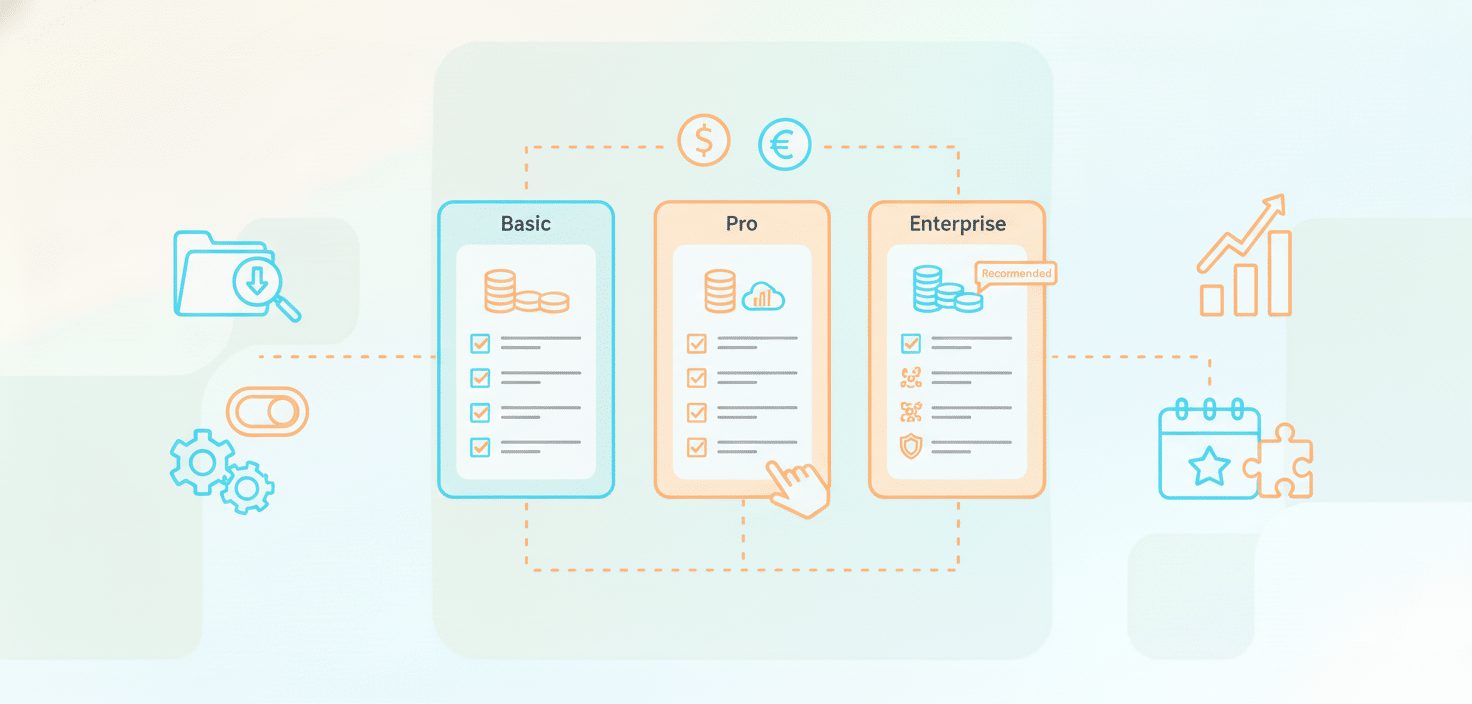
What is SaaS feature-based pricing?
SaaS feature-based pricing is a pricing model where customers pay based on the specific features they access and use.
Unlike standardized models, this approach incorporates diverse levels of flexibility and customization, factors that bear on how user subscription changes are managed based on specific requirements. For example, a project tool might charge $10 a month for its core plan, with reporting sold as an add-on on top.
Careful planning is required, especially when combined with other models, to avoid customer confusion.
What are the benefits and drawbacks of feature-based pricing?
Feature-based pricing offers distinct advantages by tying cost to value, but it also comes with notable challenges.
Benefits (Pros)
- Increased Transparency: Customers know exactly what they are paying for, which builds trust.
- Enhanced Perceived Value: Users feel they get more for their money by selecting only the features they need.
- Greater Flexibility: Customers can create a subscription plan that perfectly matches their requirements.
- Improved Customer Acquisition: The ability to offer varied options attracts a wider customer base with different needs and budgets.
Drawbacks (Cons)
- Complexity: Implementing and managing this model can be difficult, requiring detailed tracking of feature usage.
- Potential for Underpricing: Without careful calibration, some features may be underpriced, hurting overall revenue.
- Customer Confusion: Too many choices can overwhelm customers, leading to “decision paralysis.”
- Risk of Feature Cannibalization: One feature might inadvertently diminish the value of another if not priced correctly.
Feature-based vs. tiered pricing: What are the key differences?
Understanding the distinction between feature-based and tiered pricing is crucial for choosing the right strategy for your business.
| Aspect | Feature-Based Pricing | Tiered Pricing |
| Core Concept | Customers select and pay for individual features or bundles of features. | Customers choose from pre-defined packages (tiers) that include a set collection of features and usage limits. |
| Customization | High. Customers create their own plans. | Low to Medium. Customers are limited to the options within each tier. |
| Value Alignment | Precise. Cost is directly linked to the value of specific functionalities. | General. Cost is linked to a group of features, some of which a customer may not need. |
| Management | Complex. Requires significant investment in tracking and managing individual feature usage. | Simpler. Easier to communicate and manage a few distinct tiers. |
| Best For… | Products with a diverse user base and a wide range of distinct, valuable features. | Products where customer needs can be easily grouped into distinct segments (e.g., “Basic,” “Pro,” “Enterprise”). |
Feature-based pricing also differs from usage-based pricing, where customers pay for the volume they use, such as data, time, or storage (Thales), and from per-user pricing, which charges by seat.
What factors influence the choice between feature-based and tiered pricing?
SaaS companies need to consider the following aspects:
- Diversity of Customer Needs: If your customers have highly varied needs, feature-based pricing is ideal. If their needs cluster into a few groups, tiered pricing or bundled pricing is more effective.
- Product Complexity: Complex software platforms often benefit from feature-based pricing. Services with clear usage limits (e.g., number of projects, amount of storage) work well with tiered pricing.
- Strategic Goals: Your pricing model must align with your financial and strategic objectives, taking market competition and customer data into account.
Is feature-based pricing right for my SaaS?
Whether SaaS feature-based pricing is the right fit depends on three elements:
- Ideal Candidate: This model is a strong fit for SaaS products that are complex and offer a wide variety of features.
- Core Requirement: You must have the ability to track granular usage data to ensure accurate billing and revenue optimization.
- Recommendation: It is crucial to test different pricing strategies, monitor feature adoption, and have robust tools in place to manage the plans effectively.
How to implement feature-based pricing effectively?
To implement feature-based pricing, follow five steps:
- Identify Core Features: Determine which features provide the most value and can be clearly differentiated at various price points.
- Design Tiered Plans: Bundle features into logical plans (e.g., Basic, Premium). This helps cater to diverse customer segments.
- Operationalize Billing & Tracking: You must implement a robust system to handle complex billing and track usage accurately. This provides valuable insights into feature adoption.
- Use Strategic Tactics: Offer a free trial with limited features to attract users. Employ price anchoring by showcasing the value of premium plans against basic ones to encourage upgrades.
- Iterate: Continuously monitor feature usage and customer feedback to refine your pricing strategy.
Conclusion
One effective tactic for matching a product’s price to the value it offers is feature-based pricing. By granting people authority over their subscription, it empowers users, which may improve retention and increase customer satisfaction.
However, operational difficulties are brought about by this customer-centric flexibility. Companies have to balance the advantages of exact value alignment with the difficulties of administration and implementation.
Ready to get started?


 English
 Español
 Português
 Português do Brasil
 Français
 Italiano
 Deutsch
 Nederlands
 Polski
 Română
 Українська
 简体中文
 日本語
 한국어