

How to Qualify SaaS Leads Using the BANT Framework
Organizations wanting to determine which leads are prepared for a software purchase often use a framework that examines budget, authority, need, and timing.
Studies indicate that a substantial share of marketing leads (over 79%) do not immediately develop into sales, and evaluating these leads can be a measured process for sales teams, as stated by 34% of sales professionals.
This guide outlines routine steps for organizing prospects, so teams can review how resources are distributed among contacts that may advance in the sales process.

Concept snapshot
-

Category: Lead Qualification
-

Used By: B2B SaaS platforms
-

Primary Purpose: Filter prospective software buyers
-

Related Concepts: Ideal Customer Profile, Lead Management, Product-Qualified Lead
-

Stage in Growth: Early Stage to Scaling
Establish Your Demographics and SaaS Lead Qualification Criteria
The starting point for efficient lead qualification: identifying concrete factors that show which accounts are structured to buy your software and which probably are not. Teams usually rely on a mix of user and organizational data – the interaction between a prospect’s role and the scope of their company. By defining your baseline criteria, you clarify which leads match your definition of ‘sales-ready’ and which don’t quite fit that picture yet.
When you collect qualified leads, build your inbound forms to effectively capture just a few relevant details, like a verified company email. When added to background enrichment tools, this way includes information such as company size and industry. Categories for segments may develop further as more data comes in.
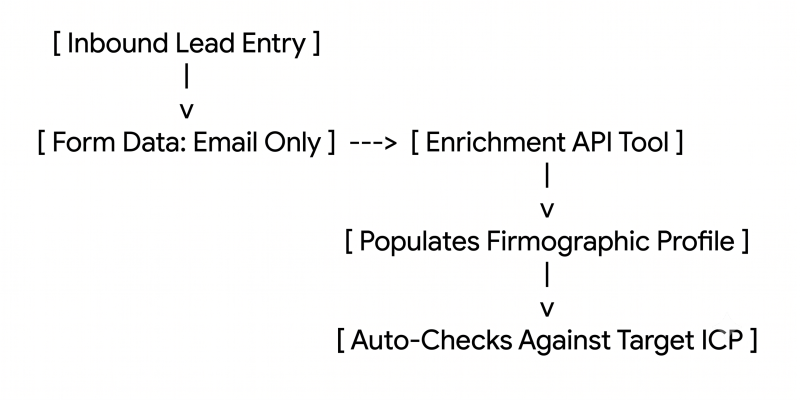
Industry research in B2B sales indicates that lead scoring aligned to these categories can relate to improvement in conversion rates by up to 75%. Keeping web forms brief and concentrating on a minimal set of reliable data at the start can potentially make initial collection more consistent.
Rather than asking about budgets on public forms, many teams rely on capturing basic details and only discuss financial information after an initial conversation. Budget questions on forms may receive a variety of responses that are general or context-dependent. Opting to discuss budget later typically positions the conversation as another step in the routine qualification process, rather than treating it as a separate hurdle.
Free SaaS Lead Qualification Checklist
Score SaaS leads faster using the classic BANT sales qualification framework.
-

B2B SaaS lead qualification criteria
-
Strategic questions
-
Telemetry milestones
-
Instructions to align marketing and sales
-
PQL metrics
-
and more!
Implement the BANT Sales Qualification Framework
The BANT framework is a structured method for gathering relevant facts about a potential buyer’s position in the purchasing process.
There’s no strict sequence – many sales teams collect details organically during the first conversations. With information about Budget, Authority, Need, and Timeline, companies can form practical estimates about points such as project close dates and expected deal sizes.
For a more thorough evaluation, connect each BANT area to clear, targeted questions:
- Budget: Clarify what amount has been allocated for this type of purchase.
Consider asking, “What is your usual range for products like this?” or “How do you determine spend for tools that address similar needs?”
- Authority: Identify who needs to approve the purchase.
For example, “Could you describe your organization’s steps before agreeing to new platforms?” or “Who else in your department needs to review things before a decision is made?”
- Need: Establish what business issue drives the conversation.
Requests like “What’s the main bottleneck you want to address?” or “If this isn’t solved this quarter, what are the effects?” are useful.
- Timeline: Confirm what the timing looks like from their side.
Prompts might be, “Are there deadlines to be aware of?” or “Do upcoming projects affect your desired implementation date?”
The engineering manager has an agreed budget of $15,000 from the VP of Engineering, describes a clear technical pain point, like eliminating a database latency issue causing customer churn, and states a deadline of deploying the fix before Black Friday.
To select between traditional or adjusted versions of BANT, organizations often review average contract value and buyer complexity.
When software purchases involve lower costs and just one buyer, the classic BANT framework works perfectly, as these transactions tend to involve less coordination. On the other hand, more complex deals that span multiple teams or compliance needs typically require a broader qualification process. In these cases, companies might review a range of requirements, group budgets, and any critical dates tied to business activity instead of hunting for a single decision-maker, and link the purchase timeline directly to corporate triggers like contract renewals or regulatory compliance dates.
Free SaaS Lead Qualification Checklist
Score SaaS leads faster using the classic BANT sales qualification framework.
-
B2B SaaS lead qualification criteria
-
Strategic questions
-
Telemetry milestones
-
Instructions to align marketing and sales
-
PQL metrics
-
and more!
Automate Scoring and Digital Interaction Tracking
Manual review often involves additional process steps and uses an extended processing window. Automation tools review user activity at regular intervals, so team member involvement is limited to required times. At this step, the platform applies point values to particular actions, grouping leads by activity when scores are updated.
To automatically qualify leads, set up tracking triggers within your marketing automation tools and CRM systems. The platform scores behaviors dynamically to gauge real intent levels:
|
[ User Interaction ] -> [ Automation Script Scales Points ] -> [ Threshold Met ] -> [ CRM Alert to Rep ] |
- Content Engagement (+5 Points): Examples include file downloads or joining product webinars.
- High-Intent Web Visits (+15 Points): Registers when there are multiple visits to pricing or comparison pages within a 48-hour window.
- Sales Action Triggers (+30 Points): Considers activities such as requesting a live technical demonstration or submitting an official Request for Proposal (RFP).
|
Lead Score Category |
Cumulative Score Range |
Automatic CRM Action Triggered |
|
Poor / Cold |
0 – 15 Points |
Route to automated educational email drip sequence. |
|
Moderate / Warm |
16 – 49 Points |
Trigger targeted case study delivery based on industry type. |
|
Great / Hot |
50+ Points |
Assign immediately to an account executive for direct call outreach. |
Free SaaS Lead Qualification Checklist
Score SaaS leads faster using the classic BANT sales qualification framework.
-
B2B SaaS lead qualification criteria
-
Strategic questions
-
Telemetry milestones
-
Instructions to align marketing and sales
-
PQL metrics
-
and more!
Track Product Qualified Leads (PQL)
In SaaS, when a free trial or freemium experience is offered, watching user interaction patterns in the actual product delivers clearer signals than collecting only self-reported interest.
A Product Qualified Lead (PQL) is a user who has carried out measurable activities in important sections of your platform. By documenting usage markers like these, companies can determine which accounts have reached defined thresholds connected to an expansion or enterprise upgrade conversation.
To track product qualified leads (PQL) accurately, engineering teams typically install product analytics frameworks that capture activity logs in real time. It’s more informative to analyze consistent product engagement than just login frequency.
|
[ User Logs in] -> [ Platform Monitors Key Feature Events ] -> [ Value Threshold Achieved (PQL) ] |
- Workspace Expansion: Noting when a user brings three or more team members into their workspace during the initial week.
- Data Ingestion Volume: Checking when usage volume on a free-tier account reaches 80% capacity within ten days.
- Integration Activation: Recording when a user connects the product to internal tools via APIs or native integrations.
Establish automated Slack or email alerts that notify the sales team when a user from an eligible domain meets a selected activation milestone. Sales teams use these alerts as reference points to time follow-up based on defined interaction criteria.
Free SaaS Lead Qualification Checklist
Score SaaS leads faster using the classic BANT sales qualification framework.
-
B2B SaaS lead qualification criteria
-
Strategic questions
-
Telemetry milestones
-
Instructions to align marketing and sales
-
PQL metrics
-
and more!
Align Sales Methodologies and Systems
Applying a defined sales process specifies a sequence of steps and shared terms for team members during sales activities. This structure mainly records sales actions and keeps reviews organized during inter. Defined phases also structure how opportunities are reviewed through each part of the process.
For SaaS sales, three main methodologies exist:
- MEDDIC / MEDDPICC: Focuses on Metrics, Economic Buyer, Decision Criteria, Decision Process, Paper Process, Identify Pain, and Champion. It is often applied where several departments may be part of the purchase review, especially when timelines are extended.
- SPICED: Evaluates Situation, Pain, Impact, Critical Event, and Decision. The focus is to compare product capabilities with items regarded as requirements by the client.
- Challenger Sales: Here, representatives cover matters like challenges within the sector, alternative tools, and alignment with aspects described by the purchasing group. Cost discussion is generally addressed after these points are covered.
- Reps sometimes use BANT as a strict list of questions on the call. The trend will make buyers stop thinking in the middle of the conversation. Another approach would be integrating the questions within regular talk. Instead of “What is your budget?” reps can ask “When companies face a similar data loss problem, they invest about $20,000 trying to resolve the issue internally. Does it match the plan that your team has for an external system?”
- The Shadow Buyer Trap occurs when reps spend months with an interested contact who likes the product but holds no signing authority inside the company. One way to address it is to require reps to verify the economic buyer’s title and budget control before marking any opportunity as qualified in the CRM.
Conclusion
If a software startup implements a lead qualification process, accounts can be segmented and resources assigned based on neutral criteria.
Applying BANT criteria with real-time product usage data shows a clear view of sales pipeline movement. Reviewing past conversion rates and similar metrics regularly gives teams input for updating their scoring methods when needed as external factors evolve.
Ready to get started?
We’ve been where you are. Let’s share our 20+ years of experience and make your global dreams a reality.

FAQ
-
A Marketing Qualified Lead, or MQL, is someone who’s interacted with your marketing touchpoints, maybe by checking out helpful guides or reading blogs you’ve posted. When a Sales Qualified Lead (SQL) gets into the picture, that means sales reps have assessed the person’s interest and activity, such as requesting a product demonstration or asking for pricing, so they’re showing real signs of considering a purchase. For Product Qualified Leads (PQLs), these individuals have actually used your software during a trial phase or with a freemium account and reached certain usage milestones, pointing toward genuine product engagement.
-
The BANT approach is generally used as an initial technique to verify key qualifications for transactional or mid-market sales, especially when the typical sales cycle is under three months. In more complex cases where several stakeholders take part in purchasing, sales teams often choose frameworks like MEDDIC to systematically record the process involving multiple individuals.
-
Instead of beginning by asking for budget details, sales teams sometimes explore broader business needs and processes, aiming to see where a software purchase fits. They may pose questions about how existing operational challenges are managed or how spending on similar software has worked in the past. By discussing these points, both sides can identify specific areas where software solutions align with operational requirements.
-
A buying window often matches actual changes inside a company – maybe contracts need renewal, there’s an internal review happening, leadership shifts, or the business is planning a bigger initiative. When these types of events arise, buyers often connect decisions to specific dates; that tends to clarify timing for both their team and the seller.
-
Sales reps consider disqualification when there is a clear separation between what leads expect in terms of outcomes or technical specifications, and what can be met given available resources. For instance, an organization might require integrations associated with enterprise security, but its financial scope is limited to entry-level offerings; in these circumstances, reaching an agreement may not be possible. Addressing qualification in earlier stages allows sales teams to distribute their efforts based on the overall fit between a prospect’s situation and available offerings.


 English
  Español
  Português
  Português do Brasil
  Français
  Italiano
  Deutsch
  Nederlands
  Polski
  Română
  Українська
  简体中文
简体中文  日本語
日本語  한국어
한국어