
SaaS Product Development
What is Technical Debt in SaaS?
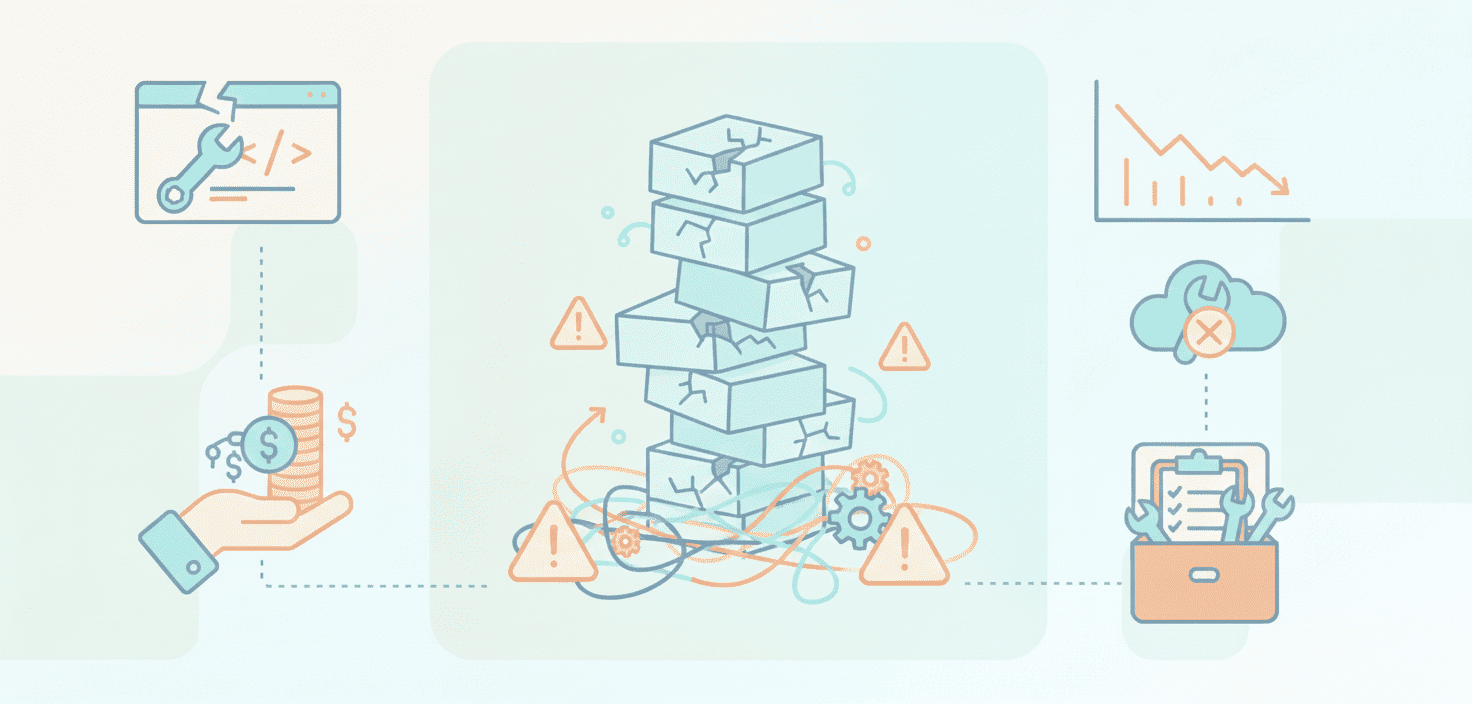
What is technical debt in SaaS development?
Technical debt in SaaS is a trade-off between implementing a fast solution and potentially incurring future rework costs compared to investing in a more thorough approach.
This approach may emphasize speed, potentially influencing effectiveness.
In startups, some technical debt may be an effective strategic trade-off in the early stages of product development to test its viability. However, if left unmanaged, technical debt grows over time and consumes a large number of development resources, limiting future innovation.
What are the different types of technical debt in SaaS?
Technical debt in SaaS includes three main types:
- Intentional debt: taken on purpose
- Unintentional debt: results from mistakes or poor choices
- Environmental debt: accumulated because of external factors, such as technological change
Within these groups, there are sub-categories such as:
- code debt
- architecture debt
- test debt
- data debt
It is important to understand the difference between these types of debt and to apply appropriate management strategies to avoid future development obstruction.
How does technical debt manifest in SaaS products?
Technical debt in SaaS applications describes the development shortcuts that later determine how smoothly a team can introduce new features and refine the ones already in place.
This shapes the pace of innovation, since development time is divided between maintaining existing code, adjusting current structures, and reviewing security considerations, alongside building new functionality.
A product that reaches launch quickly tends to rely on security testing added afterward to protect its data, and a product with brief documentation invites new developers to spend more time and budget learning the system, which shapes how readily it can scale.
Focus on coding quality, testing, and clear documentation to avoid the accumulation of technical debt.
Is technical debt always bad for SaaS companies?
Technical debt can have both positive and negative impacts on the growth of SaaS companies. However, carefully tracking it to ensure it does not reach a critical level is crucial.
Technical debt:
- Provides a method for idea validation, which may influence how SaaS teams adapt in response to user feedback.
- Can be perceived as a calculated risk, which in certain cases may yield a competitive edge in a fast-paced, pressured industry.
Still, technical debt can:
- lead to increased development costs if managed poorly.
- result in lower-quality service, exposing users to various bugs, system instability, and performance issues.
- open the door to security issues and exposure to data breaches.
- affect scalability potential, hindering SaaS growth
How does technical debt affect the scalability and time to market of a SaaS product?
SaaS product development and new feature launches can be influenced by technical debt considerations.
Challenges may arise in the maintenance and updating of tools, potentially affecting a SaaS company’s ability to keep pace with market demands. With technical debt, developers can spend a significant amount of time fixing bugs and system errors instead of innovating.
For instance, adding a new feature might become much more expensive due to convoluted code or require extensive refactoring, directly impacting project value and potentially leading to cost explosions.
Consider implementing technical debt management and strategic approaches to avoid wasting time and resources on projects that will not bring in enough value.
What strategies can SaaS companies use to effectively manage technical debt?
SaaS companies can manage technical debt with a step-by-step process:
- Create a technical debt monitoring and management system.
- Integrate automated testing, backed by unit testing strategies, and continuous integration/deployment (CI/CD) systems. These tools will help to identify and fix issues early in the development process.
- Ensure continuous improvement by having a regular code review and refactoring process, applying cloud native architecture, and incorporating observability into the DevOps processes.
Netflix has a ‘chaos engineering’ approach where various system aspects are deliberately broken to identify and fix weaknesses. This helps avoid small problems from becoming big incidents that can disrupt the whole system.
Having such a plan of best practices in place is important in controlling technical debt.
Conclusion
Technical debt in the development of SaaS applications includes the cost of using shortcuts. While it might hinder the ability to be innovative and to scale the SaaS product, strategic technical debt can help in speeding up the development and the validation of the product in its early stages. However, when accumulated excessively, it may increase costs, reduce the quality of the service, and increase the number of security vulnerabilities. These aspects can be avoided by implementing monitoring systems, testing methods, and continuous improvement.
Ready to get started?


 English
 Español
 Português
 Português do Brasil
 Français
 Italiano
 Deutsch
 Nederlands
 Polski
 Română
 Українська
 简体中文
 日本語
 한국어