

How To Set Up Metered Billing: A Step-by-Step Guide
Para set up faturamento por consumo, you have to put in place systems to monitor the consumption of the product by the customer, apply pricing rules to this data, and then generate invoices based on the usage. There are several reasons why a software as a service (SaaS) company may consider moving to a usage-based pricing model. This approach relates to a company’s capacity to represent its product’s value in the determined price. The implementation of such a model in practice is influenced by a range of variables.
This guide takes you through the process of creating a step-by-step strategy for selecting measurement parameters, setting up event tracking, and implementing a functional metered billing system.
Before launching, check it at the stage of preparation by considering some common questions:
- Is the cost of the goods and services provided to customers dependent on the number of the user’s actions, or are the hosting costs fixed, irrespective of the level of usage?
- Are the users who perform the most work more than 10 times as valuable as the average user?
- Do your target customers want a clear monthly bill, or do they feel comfortable with the idea of paying a fee for each and every activity?
These kinds of questions help convey an understanding of consumption, and especially whether it is basic or dual, or prepaid cards.

Visão geral do conceito
-

Categoria: Infraestrutura de Faturamento de Assinaturas
-

Usado Por: Plataformas e startups B2B SaaS
-

Propósito Principal: Align pricing with usage volume
-

Conceitos Relacionados: Precificação baseada no uso, SaaS License Metering, Usage-Based Subscription
-

Estágio de Crescimento: Product Launch through Global Expansion
Define the Usage Metric
Developing the right metric is a balance of what is technically possible to track with what the customers want. The metric should be directly related to what users think is valuable and useful and, at the same time, easy for engineering to measure.
Developing an abstract or incorporating multiple measurement variables into a category can influence the audience’s understanding of its specific components. The application of an abstract or multi-variable rate for billing purposes may necessitate users contacting support for details concerning invoice reconciliation. It is better to prepare such concepts clearly and in advance, and so avoid complicating the cleanliness of the billing data, the accuracy of the values, and the creation of effective charges.
| Metric Type | Common Use Case | Industry Example | Alinhamento do Valor para o Cliente |
| Count | API requests, emails sent, workflows run | Twilio, SendGrid | Clear, direct action-based billing |
| Sum / Volume | Data storage (GB), compute hours, LLM tokens | AWS, OpenAI | Directly ties resource cost to usage |
| Max / Peak | Peak concurrent seats, maximum active projects | Datadog | Captures capacity demands |
| Last / Snapshot | Active user counts at cycle end | Slack | Easy to understand snapshot billing |
Twilio charges for every request made to its API or sent SMS, while AWS charges based on time and resources.
In 2014, HubSpot implemented a usage-based pricing tier, linked to the contact database size at the IPO. This adjustment was associated with a net revenue retention rate of nearly 100%, as it related costs to customer growth.
Before giving the option to select a combination of primary metrics, it is better to focus on a single metric. Commencing with an excessive number of activities or items in the funnel can present challenges for monitoring progression and may result in a greater likelihood of billing discrepancies.
Findings from a Rob Roy Consulting survey show that 73% of B2B customers identify aspects of tech vendor transparency that warrant attention. Clear, specified usage metrics, drawing from a singular product attribute, can relate to perceptions of trust during the billing interval.
PayPro Global has powerful catalog management functionality that allows different teams to use different pricing strategies based on units, camadas, or attributes without having to modify the underlying database structure.
FREE Actionable Metered Billing Checklist
Set up metered billing, usage-based pricing, and automated SaaS billing effortlessly.
-

Essential usage metric selection criteria
-
Step-by-step event ingestion pipeline requirements
-
Real-time tracking and dashboard specifications
-
Complete rating logic and invoice automation steps
Establish Real-Time Usage Tracking
Para criar uma event pipeline, it is necessary to start recording the user’s activity in the application where the work is being done immediately, with no delays. Every action that is performed on the account should be marked as such and include additional information, such as the time of the action. The accuracy of event recording has an influence on the alignment of resource utilization with billing processes, avoiding perda de receita.
The engineering team should also have an effective system in place to handle spikes in the amount of traffic without compromising the reception of the events.
The accuracy of event recording has an influence on the alignment of resource utilization with billing processes.

Use an idempotency key for each event payload to avoid counting the same event twice in case of retries. The functionality of systems influences the collection of usage and sales data, as well as other event records; deviations can relate to variations in revenue outcomes.
To avoid such situations, place event streams through reliable message queues like Kafka or SQS with dead-letter queues.
This is what a typical event log entry looks like when it is being sent to one of the integration endpoints:
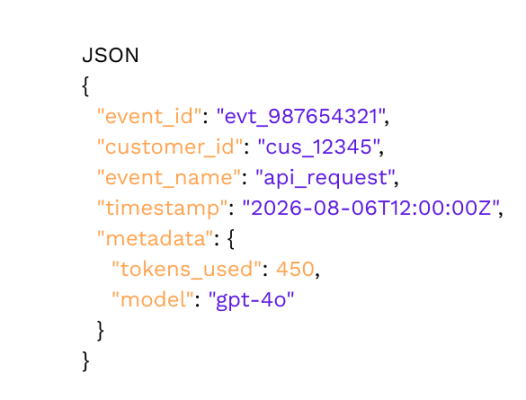
The event_id key must be unique at the database level and should be enforced at all costs. Should a network disruption occur during event transmission, and the client subsequently reattempt the operation, the database discards the redundant entry.
PayPro Global supports webhooks and REST APIs for high-volume event processing, ensuring there are no issues with the flow of event logs into customer accounts.
FREE Actionable Metered Billing Checklist
Set up metered billing, usage-based pricing, and automated SaaS billing effortlessly.
-
Essential usage metric selection criteria
-
Step-by-step event ingestion pipeline requirements
-
Real-time tracking and dashboard specifications
-
Complete rating logic and invoice automation steps
Implement Aggregation and Rating Logic
Raw usage data needs to be transformed into actual money through the incorporation of appropriate time periods ou aggregation windows. This step renders the conversion of extensive database event data into specific usage levels unnecessary. The rating engine then multiplies the levels by the rate cards, adding discounts or volume discounts where applicable, as long as the thresholds are met.
Precise aggregation windows are relevant for preventing duplicate customer charges and for establishing clear time zone definitions across customers in different geographical areas.
Sum → Adds total units consumed during the billing window (e.g., total gigabytes transferred).
Count → Totals individual actions (e.g., total API calls).
Max → Captures the highest peak value recorded during the cycle (e.g., peak concurrent users).
Last → Uses the final recorded value at the end of the billing cycle (e.g., active storage occupied).
The rating system should include the compiled scores of these activities and be based on a unitary rate, or rates adjusted to account for volume, or a combination of the two where a base subscription allowance is included.
| Estratégia de Preços | How Charges Are Calculated | Best Fit For |
| Puro Pagamento por Uso | Units consumed × Per-unit rate | Developer tools, cloud compute |
| Tiered with Overages | Base plan fee + (Units over limit × Overage rate) | SaaS B2B platforms |
| Volume-Based | All units billed at lower rate once threshold is reached | Bulk messaging, email delivery |
| Créditos Pré-pagos | Deduct units from pre-purchased credit wallet | ferramentas de IA, GPU processing |
In various instances, the invoice period can differ from the duration of service provision and the point of actual resource consumption. To avoid the common customer disputes caused by these mismatches, ensure server timestamps, database rollups, and invoice cycles all operate on standardized UTC.
FREE Actionable Metered Billing Checklist
Set up metered billing, usage-based pricing, and automated SaaS billing effortlessly.
-
Essential usage metric selection criteria
-
Step-by-step event ingestion pipeline requirements
-
Real-time tracking and dashboard specifications
-
Complete rating logic and invoice automation steps
Build Customer Usage Dashboards & Alerts
Greater insight into usage relates to users’ ability to manage upcoming expenditures. A customer dashboard displays the consumo, o custo of the monthly subscription, and the amount of the remaining limit.
Automated notifications are dispatched upon reaching a specified usage level, enabling teams to consider reducing activities or modifying budgetary allocations.
Isso transparência influences the predictability of final invoice amounts and correlates with changes in the customer base.
| Alert Threshold | Trigger Event | Customer Action |
| 50% Allowance | Mid-cycle consumption milestone | Info email with current spend pace |
| 80% Allowance | Approaching plan limits | Warning notification to optimize usage or upgrade |
| 100% Allowance | Plan limit reached | Option to enable auto-overage or hard usage caps |
A correlation exists between unpredictable bills and financial considerations, which can relate to rotatividade. Create an alert system that is triggered when the customer reaches the thresholds set for the levels of credit, such as 50%, 80%, and 100%. Users can utilize spending limits or credit wallets for budget regulation and to address infrastructure expenditures.
An AWS user’s operational costs include a monthly $1.3M attributed to test scripts without a defined current function. Automatic threshold alerts can help to avoid such spikes by informing the appropriate persons about the fact that consumption goes beyond the historical limits.
Offer both prepaid and postpaid billing options. Advance credit top-ups for customers relate to the ability of enterprise account holders to monitor their annual budgets.
FREE Actionable Metered Billing Checklist
Set up metered billing, usage-based pricing, and automated SaaS billing effortlessly.
-
Essential usage metric selection criteria
-
Step-by-step event ingestion pipeline requirements
-
Real-time tracking and dashboard specifications
-
Complete rating logic and invoice automation steps
Connect to a SaaS Billing Engine
The last step is to link your consented usage data with an faturamento automatizado system to enable payment. At the end of each billing period, rated charges are added to base subscriptions, regional taxes, and active discounts to create a detailed fatura.
Automated billing systems process payments through merchant accounts and then save the information in the main accounting systems. This step is intended to facilitate a consistent transfer of products, usage, and funds from the bank.
The specified factors lead to a process with a different degree of operational effort compared to tarifa fixa invoicing. The taxable amount is not determined until the end of the period; thus, tax should be computed for each jurisdiction at the time of invoice generation instead of at the time of creation of the whole plan.
Prepaid cards introduce an additional factor into the current considerations. Credits are classified as an asset during the sale phase, transitioning to a liability once deployed, with revenue generation occurring through their utilization rather than their initial distribution.
When configuring a new installation, one of the principles is to avoid conflicting events and therefore make sure to use unique event_id fields. Also, all server logs should be in UTC, and last but not least, have a local buffer to save any events that might have been collected when the server was down.
PayPro Global atua como um Merchant of Record (MoR) with a platform to manage processamento de pagamentos globais, create invoices, handle local currencies, comply with international regulamentações fiscais (VAT/GST), and effectively defend against chargebacks on a single platform.
Conclusão
Para alcançar uma usage-based SaaS pricing model, it is necessary to identify clear consumption metrics, put in place an idempotent event pipeline, and provide customers with real-time visibility into their activities. This technical process is called faturamento por consumo.
These steps establish a framework for an automated SaaS billing process that relates usage to revenue. Monitoring tools e threshold alerts can influence the occurrence of billing issues and the stability of functioning.
Perguntas frequentes
-
Usage-based pricing is a business strategy in which the amount charged to customers is dependent on the product activity. Metered billing is the technical process that involves the measurement, aggregation, and billing of consumption
-
Yes, this kind of pricing is called a hybrid pricing model. Customers pay a fixed amount as a subscription for the platform, plus a fee for each additional feature or application. With metered billing, customers are charged for every unit of a product or service, such as water or electricity.
-
Select a metric that is directly proportional to the value that the user gets from you, such as the number of API calls, stored GBs, or compute hours. The unit should be simple and clear on the invoice and easy for the engineering team to measure.
-
Avoid shock by displaying actual usage and costs on a customer-facing meter or dashboard that is updated in real time throughout the billing cycle. In addition, it is important to create thresholds to notify users when their consumption reaches a certain percentage of the budget.
-
Idempotency is a property of a system that ensures that if the same event is sent more than once and has the same unique ID, it will be processed only once. This helps in preventing customers from being charged for unrendered services by addressing situations where clients reapply with the same information within a short timeframe, and the database has not yet cleared earlier application data.
-
Set a reasonable time limit—usually 24 to 72 hours—during which delayed events can be collected and integrated into the active billing cycle. Anything after the cutoff time should be taken to the next period or created as a credit adjustment.
-
In contrast to fixed subscriptions, metered billing depends on variable monthly recurring revenue derived from customer usage. To improve cash flow, many organizations require a minimum monthly commitment or pre-purchase credit cards.
-
You need to have in place an event processing pipeline that includes message queues, an aggregation system to derive meaning from the raw metrics, and a rating engine. This layer, positioned between the application and the payment gateway, is designed to affect throughput and enable the auditing of figures.
Pronto para começar?
Já estivemos onde você está. Vamos compartilhar nossos mais de 20 anos de experiência e tornar seus sonhos globais uma realidade.


 Português
 English
 Español
 Português do Brasil
 Français
 Italiano
 Deutsch
 Nederlands
 Polski
 Română
 Українська
 简体中文
 日本語
 한국어