
SaaS Payments
What is SaaS Prepaid Billing?
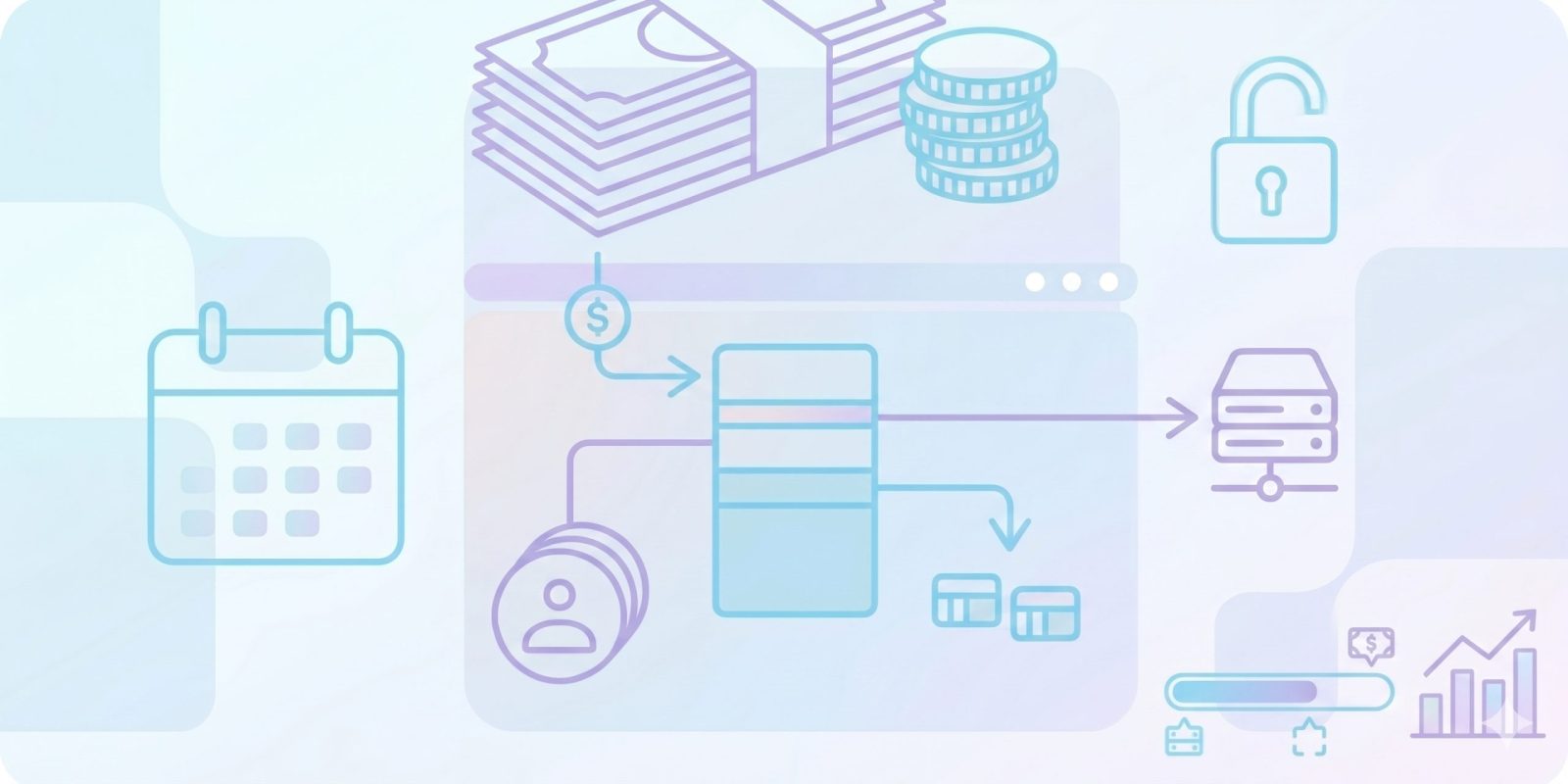
What is SaaS Prepaid Billing?
SaaS prepaid billing is a payment method where clients pre-fund an account by either topping up with a specific amount or purchasing a corresponding number of credits. These are then gradually deducted as clients use the respective features or services. The key in this approach is that a user’s activities are initiated only once the associated payment has been processed.
SaaS prepaid options relate to API-driven products, developer tools, and platforms that feature fluctuating, metered usage, which can offer the provider a means of adjusting billing cycles to consumption.
How does a Prepaid Billing system work?
A prepaid system usually consists of four main pillars:
- Wallet or Balance: A credit balance can be kept in a customer account, which is funded by the customer upfront.
- Top-Up Flow: By simply adding funds, users can either manually or automatically trigger reloading when their balance is beneath the threshold volume.
- Usage Deduction: The predefined cost is deducted from the balance immediately in response to each API call, seat activation, or feature use.
- Real-Time Charging: It involves consumption monitoring, with the system reflecting fluctuations and adjusting the balance more frequently than at the conclusion of a billing period.
A pay-as-you-go pricing system is used, and balance updates are made available at short intervals.
Prepaid vs. Postpaid Billing: What's the difference?
Here is a detailed comparison of prepaid and postpaid billing:
|
Feature |
Prepaid |
Postpaid |
|
Payment timing |
Before usage |
After usage |
|
Credit position |
No impact for the provider |
Risk is transferred to the provider |
|
Cash flow |
Immediate |
Extended timeline |
|
Service continuity |
Operation is contingent on the availability of funds |
Interruptions in rapid sequence are infrequent |
|
Common in |
API products, usage-based SaaS |
Traditional SaaS subscriptions |
Postpaid billing invoices customers after a cycle ends, creating a credit relationship. With prepaid, this relationship is altered as payment is received in advance.
How to set up Prepaid Billing for a SaaS product?
Spotting a prepaid system is a relatively simple task; there are some guidelines:
- Figure out precisely what you want to charge – for example, a per API call, per minute, per GB, or per event basis.
- The next step is to construct or link up a wallet system; ordinary checkout and wallet management are handled on platforms, which natively support balance-based billing.
- Always keep a clear balance display – users need to know exactly how many credits are left on the dashboard.
- Top-up plans should be set apart, allowing top-ups to be completed with a single click; moreover, automatically refilling is a possibility.
- A low-balance email notification can be configured. Users may be alerted before their service is interrupted because of an insufficient balance.
- Your billing engine should cope with frequent deduction requests without becoming sluggish.
- Establish procedures for when a balance reaches zero. It is necessary to have a contingency plan, whether this is a hard stop, a grace period, or an automatic top-up.
- Make your refund policy easy and accessible at all times.
What are the benefits of Prepaid Billing for SaaS Businesses?
Operational impacts can be observed with prepaid models:
- The timing of the final payment, received before the project’s initiation, relates to the company’s liquidity position.
- As payment consistently occurs in advance, invoice follow-up is typically not required.
- The provider’s credit risk profile may correlate with the security of unused funds held.
- Cash availability may remain consistent despite variable usage patterns.
- The values of invoice numbers, dispute frequency, and the intricacy of the reconciliation process are subject to modification.
What are the disadvantages of Prepaid Billing?
Understanding the constraints related to prepaid billing is recommended. Here are some points to consider before implementation:
- The availability of funds can relate to customer task execution, and workflow modifications may be considered.
- Established payment preferences for net-30 or net-60 day terms may influence the adoption of a prepaid model among enterprise buyers.
- The existence of unredeemed or underused balances is associated with refunds, leading to policy management and the possibility of regulatory consultation.
- Trial conversion rates can be affected by payment requirements before usage.
Conclusion
SaaS prepaid billing has implications for cash flow speed, credit risk exposure, and receivables management. However, a well-thought-out implementation is necessary to avoid hiccups at signup and service disruptions at runtime. It also depends on whether the target customers, usage patterns, and the company’s ability to manage balances and refunds effectively are consistent with this model.
Ready to get started?


 English
  Español
  Português
  Português do Brasil
  Français
  Italiano
  Deutsch
  Nederlands
  Polski
  Română
  Українська
  简体中文
简体中文  日本語
日本語  한국어
한국어