
SaaS Payments
What is SaaS Recurring Billing?
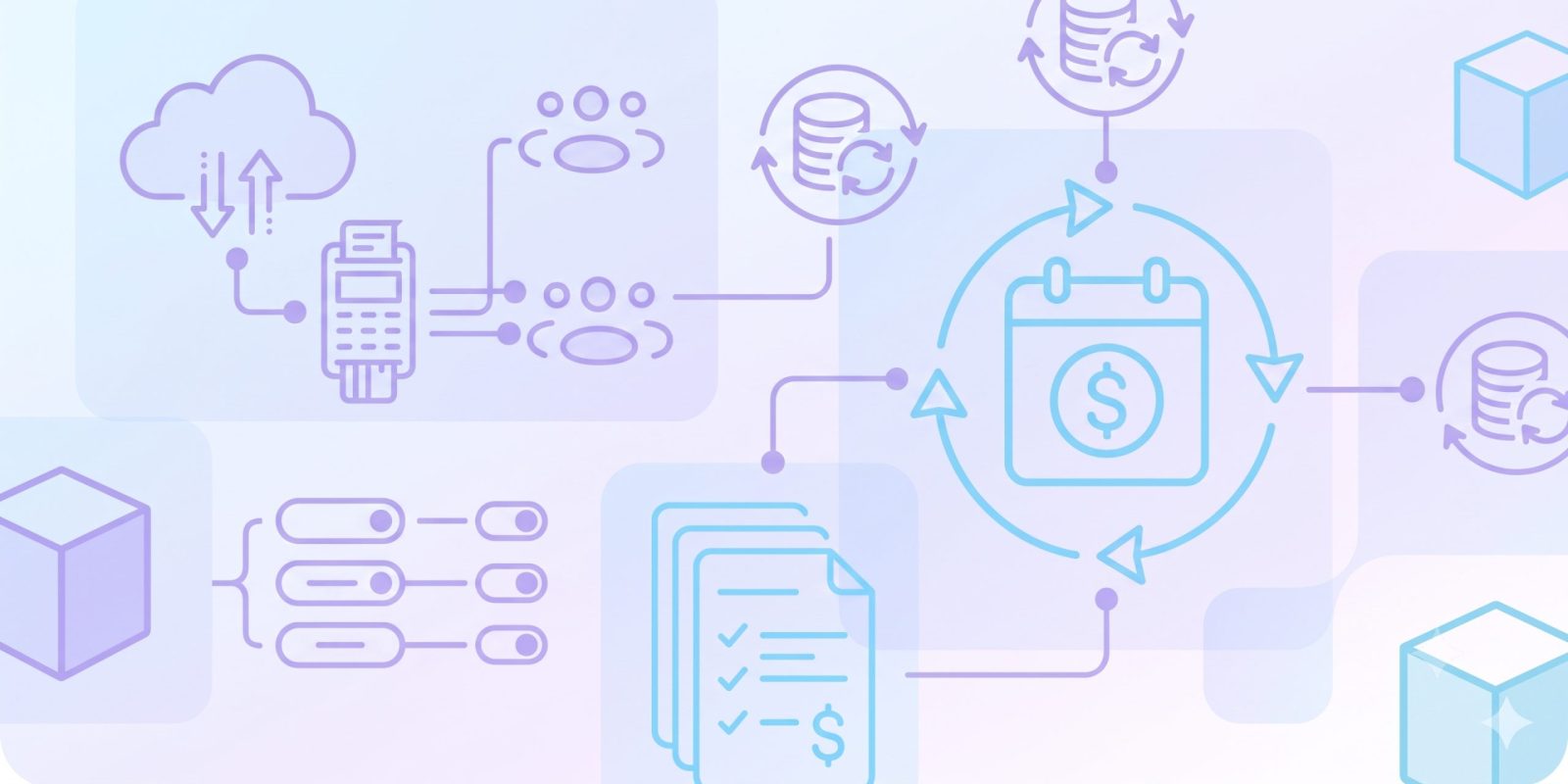
What is SaaS Recurring Billing?
SaaS recurring billing refers to the automatic charging of customers at regular intervals (monthly, yearly, or another set period) and the ongoing delivery of software during these periods so customers are charged for access. In such a situation, payments are processed on a recurring schedule until a cancellation or a modification to their billing plan occurs. This approach indicates the billing system’s role in cash flow processes, its effect on manual invoice creation effort, and its provision of MRR and ARR data to the finance team.
How does SaaS Recurring Billing differ from Recurring Payments, Metered Billing, and One-Time Billing?
Although these four can be used interchangeably, it is worth noticing that each has its place in the billing scenario:
- One-time billing refers to a customer being charged a single time, with no subsequent payments anticipated.
- Recurring payments are the actual process of a transaction, i.e., the secure storage of your bank or card details followed by repeated use.
- Metered billing (also called usage-based billing) is a model where customers are charged in proportion to what they actually use, such as API calls, storage, or the number of active accounts.
- SaaS recurring billing includes invoicing, proration, plan changes, dunning management, etc., and incorporates flat-rate, tier-based, or usage-based pricing.
What are the Recurring Billing model options?
SaaS businesses seldom rely on only one type of billing and usually have some combination of several methods such as:
- Flat-rate billing involves a consistent charge for each instance, regardless of the amount of usage.
- Tiered billing is for cases where the more a customer gets of the service, the higher the price, but in stages (Basic, Pro, Enterprise).
- Usage-based billing is when you pay for what you use with no regard for minimums or limits.
- Per-seat billing is a billing mode where the customer is charged only for users who are using the software, i.e., license holders or active customers.
- Hybrid billing is a combination of a subscription fee and usage-based charges.
If there is a tool for managing a project, they can charge a flat monthly fee per workspace and team member as they are added, thereby combining flat and seat billing.
Why does the SaaS business model depend on reliable Recurring Billing?
The operational effectiveness of payment processing influences whether subscription revenue reaches its projected levels.
Consider the following points:
- Revenue forecasts are accurate only when the underlying billing data is fully updated and complete.
- As a customer base grows beyond its initial foundation, the application of manual billing may require adjustment.
- Invoices are expected to indicate plan modifications, level changes, or downgrades.
- A robust billing system has to tie in the accounting, CRM, and reporting functions.
How do you design an effective Dunning Stack to reduce involuntary churn?
Discontinuations of subscriptions based on payment processing status are termed ‘involuntary churn,’ distinguishing them from subscriber-initiated cancellations. An efficient dunning stack consists largely of retry logic combined with automated reminder emails or in-app messages that ask the client to renew/replace the payment method.
|
Pros |
Cons |
|
A component of payments that failed is recovered |
The retry timing is subject to continuous adjustment |
|
This factor tends to result in fewer support tickets related to unforeseen cancellations |
The timing of retry attempts can influence customer experience |
|
Retention is a factor that can exist without new acquisition expenditures |
Integration with payment gateways and CRM is a requirement |
Which regulations shape SaaS Recurring Billing?
Recurring billing processes are subject to external influences, as tax and compliance regulations vary across jurisdictions and adjustments. Tax and compliance matters for different countries or states. A standard for invoices and tax could be applied to VAT and GST systems in the EU/UK/Asia-Pacific. Sales tax systems exhibit differences when contrasted with the US model. Card network regulations stipulate that customers receive straightforward information concerning subscription details, operational aspects, and a defined cancellation workflow, consistent with auto-renewal requirements in the EU and specific US states.
Ask yourself:
- Are there customers that I serve who live in jurisdictions, states, or countries where I have to follow different tax regulations?
- Does my system have such a record to support that we are compliant or to show that we follow auto-renewal regulations?
- Is being a Merchant of Record a way to lessen the burden and responsibility of compliance?
Decision factors:
- One-time payments versus income from the customers who pay for access to the service over and over again
- Scale of the business and how fast or slowly it is projected to grow
- The capacity to manage and calculate taxes across various countries
- Plans to offer usage-based or hybrid pricing
- Availability of the internal workforce to build the billing infrastructure and keep it in order
Conclusion
In a subscription business, SaaS recurring billing is instrumental in converting individual sales into a repeatable revenue flow. The success, or “good implementation,” of recurring billing depends on choosing the right pricing option, setting up a solid dunning system, and being one step ahead of ever-changing tax rules and compliance requirements.
Ready to get started?


 English
  Español
  Português
  Português do Brasil
  Français
  Italiano
  Deutsch
  Nederlands
  Polski
  Română
  Українська
  简体中文
简体中文  日本語
日本語  한국어
한국어