
SaaS-statistieken en -KPI's
Wat is Burn Rate?
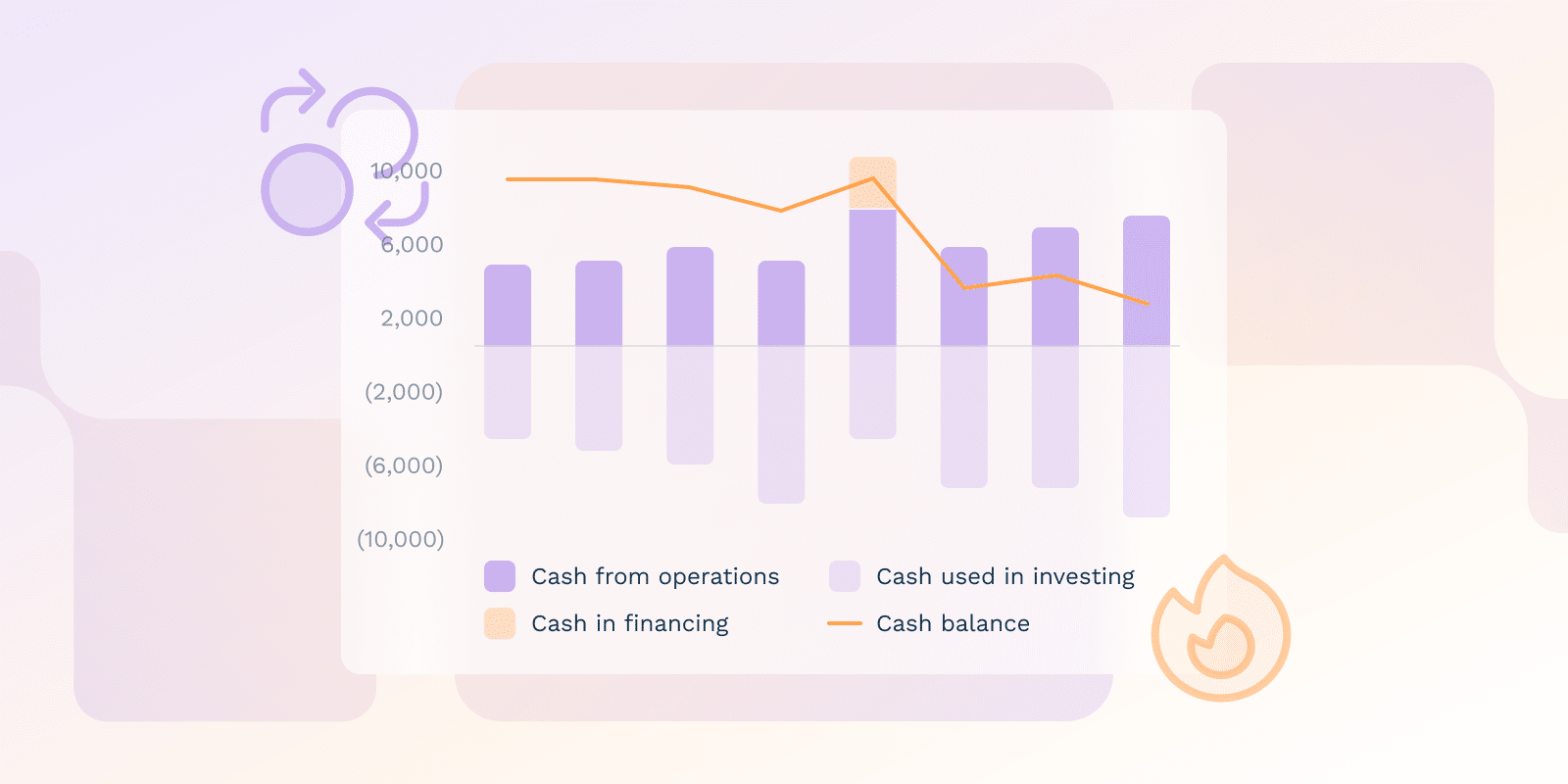
Wat is de burn rate?
Burn rate is how quickly an organization spends its cash reserves before reaching the break-even point or operating at a profit. For example, a company that goes from $100,000 to $80,000 in a month burns $20,000. This metric is especially relevant for start-ups and new businesses that are not yet earning or breaking even with the costs spread.
Knowing how long your business’s cash reserves will last is essential in properly forecasting cash requirements. The burn rate often reveals insights into a company’s financial health. While a high burn rate may suggest potential financial risk, a low rate might indicate limited growth.
Hoe wordt de burn rate berekend?
To calculate the burn rate, eerst establish the starting and ending cash balances for a time period, such as a month.
Second, take the cash balance as of the last day of the period, deduct it from the cash balance on the first day of the period, and divide door the number of months in the period.
Consider the case in which a company begins a month with $100,000 and finishes it with $80,000. The monthly burn rate is thus $20,000, which is ($100,000 – $80,000) / 1 month = $20,000.
Remember that there are two sorts of burn rates. The gross burn rate includes all the operating expenses for a given period, while the net burn rate subtracts incoming revenue from those expenses.
Welke belangrijke factoren beïnvloeden de burn rate van een bedrijf?
Burn rate is de rate at which an organization expends its reserves, usually measured per month or week, depending on the rate of expenditures. Consider the following factors:
- Bij uitbreiding controleert een bedrijf de burn rate door rekening te houden met de omvang van het bedrijf, de groeivoet, de uitgaven, de inkomstenbronnen, de kasinstroom en andere externe factoren.
- Houd rekening met de inkomsten omdat dit bepaalt hoe snel de middelen van een bedrijf kunnen worden aangevuld.
- Algemene administratiekosten en andere implicaties van financiering, zoals het aflossen van leningen, hebben een aanzienlijke impact op berekeningen met betrekking tot de totale burn rate en mogen niet over het hoofd worden gezien.
- Het beheren van overuitgaven is essentieel om op de lange termijn een voorzichtige duurzaamheid te bereiken en potentiële negatieve gevolgen voor de bedrijfsontwikkeling te verminderen.
Wat is het belang van de burn rate voor investeerders en belanghebbenden?
The burn rate is important to investors because monitoring it provides stakeholders with valuable insights into the financial health of the organization, particularly the amount of cash resources available.
By understanding the amount of risk attached Om investing in the business, as well as the rate of expenditure on cash availability, the burn rate helps determine what resources are available to support the business.
Met deze metriek wordt bepaald hoe lang een organisatie operationeel kan blijven en break-even zonder winst te maken of meer financiering te ontvangen.
Cash runway is that span in months: cash on hand divided by the monthly net burn. For instance, a business that has $480,000 of cash but loses $20,000 per month has 24 months of runway.
Wat is een goede burn rate?
Het berekenen van de burn rate omvat het identificeren van negatieve groei en het verliespercentage. Een ideale burn rate laat zien hoe snel een organisatie zijn kasmiddelen uitput zonder failliet te gaan.
In the case of SaaS companies, a healthy burn rate is typically when a company can still acquire customers while having a stable cash inflow from subscribers. A negative net burn rate, indicating a company’s positive cash flow, is a financial gauge that investors may consider when evaluating its financieel beheer. en capaciteit.
Om een gezond financieel beheer te garanderen, moet het management een voorzichtige benadering hanteren bij het gebruik van kasmiddelen en onnodige fondsenwerving vermijden.
Investors also weigh burn against growth with the burn multiple, net burn divided by net new ARR. Burning $2M to acquire $1M in ARR per quarter is a 2x multiple and, according to David Sacks (2020), is quite acceptable for a startup at an early stage.
| Bedrijfsfase | Typische kenmerken van de Burn Rate | Financiële implicaties |
|---|---|---|
| Opstartfase | ||
| Startende startup | Hoge burn rate, beperkte inkomsten | Hoge investering, negatieve cashflow |
| Seed/Pre-Revenue | Agressieve uitgaven aan productontwikkeling | Afhankelijk van investeerdersfinanciering |
| Groeifase | ||
| Schaalvergroting SaaS | Matige burn rate met stijgende inkomsten | Balanceren van klantwerving en cashbehoud |
| Gevestigde SaaS | Gecontroleerde burn rate met stabiele inkomstenstromen | Positieve cashflow, duurzame bedrijfsvoering |
| Volwassenheidsfase | ||
| Volwassen bedrijf | Lage burn rate, voorspelbare uitgaven | Sterke cash reserves, potentieel voor herinvestering |
| Marktleider | Minimale burn rate, gediversifieerde inkomsten | Strategische uitgaven, financiële flexibiliteit |
Hoe kunnen bedrijven hun burn rate productief besteden?
Businesses spend their burn rate productively when they track the costs incurred by the organization and account for financial activities regularly. Scrutinize expenditures to determine what should be cut down or improved upon. Find ways to improve cash flow, zoals using accounts receivable financing, spending less than the firm’s operating budget, and discontinuing low-profitability branches of the company.
Operationele planning en prognoses kunnen helpen bij het vereenvoudigen van het beheer van de burn rate, hoewel de resultaten kunnen variëren.
Conclusie
Measuring your burn rate will give insight into a company’s financial health and risk. Since it measures how fast the business uses its cash reserves, it’s important for planning. Consider company size, expenses, revenue, and growth rate when looking at this metric. Managing your burn rate is not a guarantee for success, but it does show potential for longevity and expansion.
Klaar om te beginnen?


 Nederlands
 English
 Español
 Português
 Português do Brasil
 Français
 Italiano
 Deutsch
 Polski
 Română
 Українська
 简体中文
 日本語
 한국어