
成長戦略
What is a SaaS Trial to Paid Conversion Funnel?
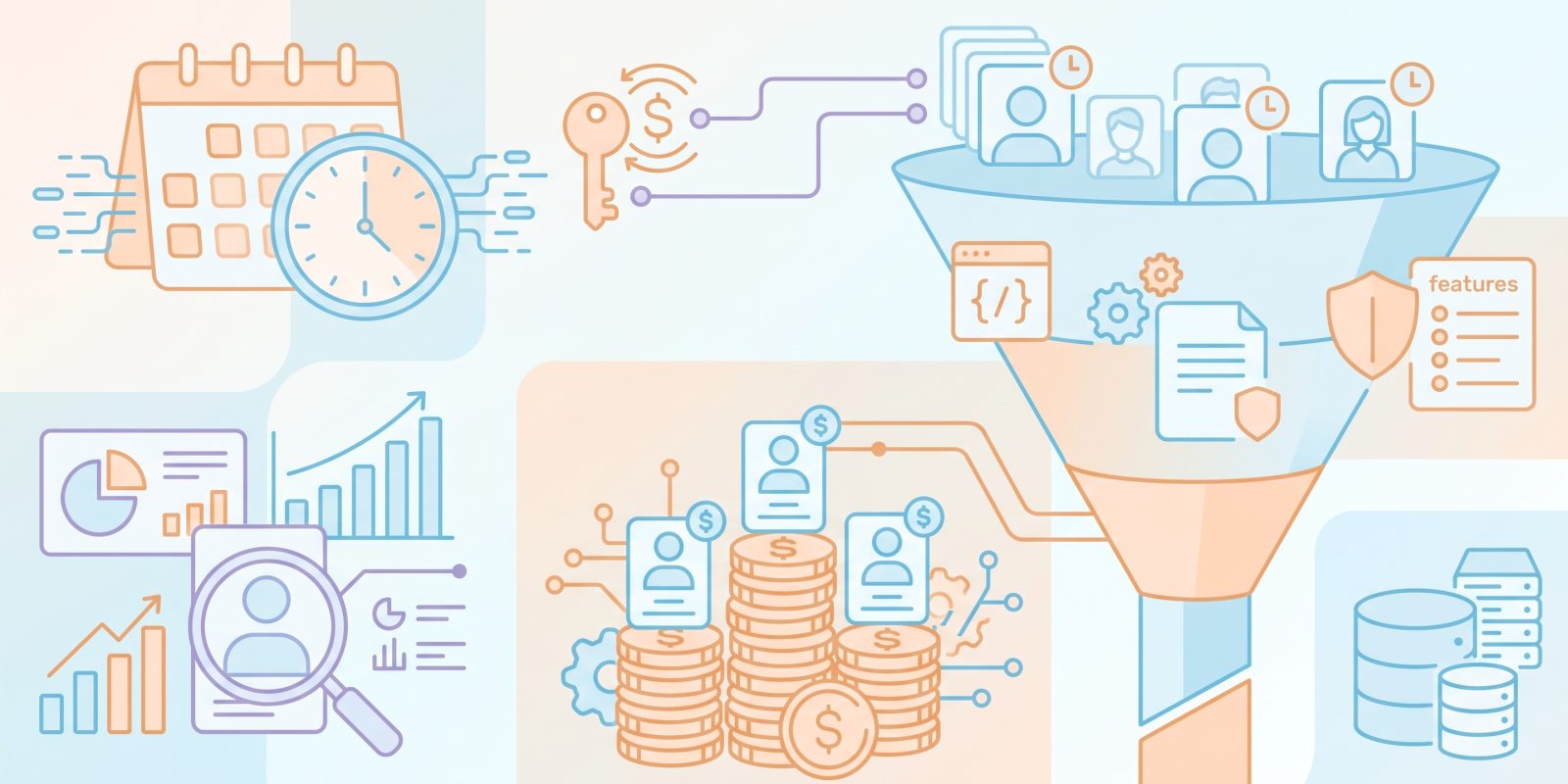
What is a SaaS Trial to Paid Conversion Funnel?
A trial to paid conversion funnel in SaaS is the events a user goes through from when they start a trial until they subscribe to the product. Rather than treating conversion as a one-time event, the funnel shows teams when users onboard, use the software in meaningful ways, see opportunities to increase their subscription, and decide to pay or leave.
How is a Conversion Funnel different from a Conversion Rate?
The user conversion rate represents one specific metric, whereas the funnel outlines the sequence of user actions that precede a conversion. For instance, a trial to paid conversion ratio gives you the percentage of your trial users who have become paying customers. Meanwhile, a funnel breaks that process into phases such as trial registration, activation, awareness of the service/product value, upgrade intent, and payment.
What stages can a SaaS Trial to Paid Funnel include?
There is no one-size-fits-all path to conversion across the SaaS industry. In their funnel, for instance, users might start to sign up, and after the trial period ends, billing details are presented. So, teams should set funnel stages to match product users’ and billing journeys using observable actions.
| 段階 | 内容 |
| Trial signup | User creates an account or starts a trial |
| アクティベーション | User completes product-specific actions linked to meaningful use |
| Value realization | The user encounters a primary outcome associated with the product’s use |
| Upgrade step | User selects a plan or encounters an upgrade opportunity |
| Checkout or payment | User provides the information required to start a paid subscription |
| Paid | The subscription becomes paid under the product’s billing rules |
The sequence of user progression through stages may differ. Some products collect payment details before the trial begins, while others introduce checkout only when the user decides to upgrade.
What is the difference between a Free Trial, Freemium, and Reverse Trial?
However, they create different paths; these models do not mean paid versions of a product have to be trial-based.
- ~においては、 無料トライアル, users are given free time and access to either the full product or a paid tier until a configured trial end point or billing period begins.
- ~においては、 フリーミアムモデル, individuals typically receive basic features, with payment required for additional functionalities, usage, or increased capacity limits.
- In a reverse trial arrangement, users who have experienced premium features for a set period without upgrading transition to a free or restricted service level.
Moreover, these models differ in upgrade opportunities and triggers: free trials set a time limit, freemium depends on a feature or usage limit, and a reverse trial lets users experience premium capabilities before losing access.
How is Trial to Paid Conversion measured?
Trial to paid conversion is measured by putting users into “groups” by trial start time and measuring their progress over a fixed conversion window.
A basic cohort calculation is:
Trial to paid conversion rate = users in the trial cohort who become paying customers ÷ total users who started the trial in that cohort × 100
The measurement window’s definition involves clarity. Depending on the product, teams may evaluate conversion within 14 days, 30 days, or another period that reflects the normal buying cycle.
Choose a cohort interval that matches signup volume and the buying cycle. Weekly cohorts can help reveal short-term changes, while monthly cohorts may be more stable for products with lower signup volume.
What should teams evaluate before optimizing the funnel?
Before changing the funnel, teams need to know where users fall off; drop-off should be compared with activation and conversion data. Furthermore, communicate the product-specific interpretation of “activation” and the level of user comprehension.
Among them, the points that can lead to the evaluation of the funnel include:
• Identify actions that result in アクティベーション.
• Calculate the 価値実現までの時間 independently of the total trial length.
• Compare the アップグレード with the timing when users experience value.
• Evaluate whether the duration of the trial period is in harmony with the typical decision-making process.
結論
Converting from a free trial to paid in SaaS: user steps from initial trial signup to paid signup into measurable phases, and the team understands whether the user moves forward or disengages. Product and growth teams can use it to assess factors such as activation rate, trial design, upgrade timing, and the payment path.
準備はよろしいですか?


 日本語
日本語  English
  Español
  Português
  Português do Brasil
  Français
  Italiano
  Deutsch
  Nederlands
  Polski
  Română
  Українська
  简体中文
简体中文  한국어
한국어