

How to Move from Perpetual Licenses to SaaS Subscriptions
To convert a software company’s business model from selling perpetual licenses to a SaaS subscription model, the company has to be restructured, from financial reporting to business processes. The adoption of a subscription model for the product involves a reclassification of customer acquisition expenses from CapEx to OpEx and establishes a source of recurring revenue.
This guide provides operational, financial, and technical steps pertinent to a business model change, with considerations for cash flow management.
Before giving the signal for the execution of the migration, consider the product architecture and the audience that includes the product and also the mode of presentation of the product, whether it is too dependent on the user’s premises or if the core customers are very strict about data sovereignty, meaning where their information is kept and whether it is allowed to be in the cloud, if so.
Also, check the available balances to see if they are sufficient for the duration of the time usually experienced during the reduction of cash flow, which usually lasts from 12 to 18 months.
Businesses that provide simple features and have a wide customer base have the option of just setting a deadline for the sale of perpetual licenses. In contrast, enterprise products have many integrations that require a phased migration approach in which customers can keep using their own hosting while also using recurring payment terms.

Concept snapshot
-

Category: Business Model Migration
-

Used By: B2B SaaS and Enterprise Vendors
-

Primary Purpose: Establish Recurring Revenue Streams
-

Related Concepts: Perpetual Licensing, SaaS Subscriptions, Automated Billing, ASC 606 Compliance
-

Stage in Growth: Early Expansion and Growth Scaling
Establish Your Revenue and Monetization Model
The first step in creating a subscription business model is to consider the delivery, packaging, and billing processes of the software. Perpetual licenses grant access to a product for the life of the license, irrespective of updates, with payment made upfront. In contrast, a SaaS subscription offers access to the product only during the duration of the agreement, which is typically renewed periodically.
This step requires studying the patterns of usage by existing customers and assigning them to the appropriate new recurring plans or upgrading existing users. It is necessary to define the primary measurement unit, which can be active users, data stored, or API calls, in such a way that the fees increase together with the growth of the customers.
It is better to lay this foundation early, as it will save everybody’s time and effort, and also avoid complications related to the preparation of the agreement and the setting of the expected revenue.
| Monetization Model | Description | Primary Use Case |
| Flat Tiered Subscriptions | Standardized service levels (e.g., Basic, Pro, Enterprise) billed monthly or annually. | Products that are clearly separated into features and have a clear understanding of how the user will use them. |
| Usage-Based Subscriptions | A billing method in which the customer is charged based on the actual usage of a product. | Tools, APIs, and platform products where the usage can be variable. |
| Hybrid Models | A fixed subscription fee plus additional charges for extras or hardware. | Enterprise applications that require access to the core product in addition to extensive resources. |
In order to increase its recurring revenue, CallidusCloud moved away from selling licenses for single applications and focused on selling subscriptions to its cloud applications. The company was operating with this strategy when it was acquired by SAP in 2018.
According to the same logic, Datrium, a company that provided storage solutions, changed the idea of selling its software together with hardware and started selling its software as a stand-alone product. In 2020, it was acquired by VMware.
Keep your first set of subscription offers simple. A number exceeding three or four price points has implications for the decision-making process and for automated billing operations.
FREE SaaS Transition Checklist: From Perpetual Licenses to SaaS Subscriptions
Streamline your move to a SaaS subscription model using our step-by-step operational strategy.
-

A list of financial metrics to track during your pivot
-
Essential steps for automated recurring billing setup
-
Actionable workflows for reorganizing customer success teams
-
Troubleshooting tips for legacy data migration
Prepare Financial Infrastructure
Upon the initial launch of a SaaS product, the company’s cash flow tends to be affected by the reduced upfront payment amount. This happens because the customer used to pay the fee to obtain the license for the software in one go, but in the case of a SaaS product, the customer pays the fee in parts over the period of the subscription, usually monthly or yearly. This concept, referred to as the “SaaS valley of death“, denotes a phase when a SaaS company’s revenue, based on its financial documentation, shows a decrease from its expected range, despite having a stable number of customers.
To prepare for the implementation of this approach, you will have to upgrade your reporting tools to enable tracking of billings made toward contracts with recognized revenue according to the rules of ASC 606 and IFRS 15. Moreover, it is better to prepare financial resources either through getting external financing or creating a cash reserve large enough to cover all the expenses during the expansion period, as your recurring revenue growth depends on this.
Perpetual Model:
Year 1: Large Upfront Payment + Small Maintenance Fee
Year 2: Maintenance Fee Only
Year 3: Maintenance Fee Only
SaaS Subscription Model:
Year 1: Monthly/Annual Payments
Year 2: Recurring Subscription Payments
Year 3: Recurring Subscription Payments + Upsell Revenue
Essential financial metrics to track
- Annual Recurring Revenue (ARR): The annual subscription revenue generated by a group of actively renewed subscriptions.
- Monthly Recurring Revenue (MRR): The sum of subscription fees that are charged regularly on a monthly basis.
- Customer Acquisition Cost (CAC): The expenses incurred in terms of money, time, or resources in seeking to acquire a new customer.
- Customer Lifetime Value (LTV/CLV): The estimated gross profit that will be generated by a customer over the entire period of their relationship with your company
- Billings: The total amount of the invoice extended to customers at the time of issuance, as it is the direct reflection of the available cash flow.
According to IDC, the compound growth rate of the cloud market, which includes Software as a Service (SaaS) and Platform as a Service (PaaS), was 18.8% annually from 2020 to 2025, increasing from $240.9 billion to $570.1 billion.
In 2012, Adobe‘s transition from packaged software to the Creative Cloud subscription model was associated with a short-term revenue decrease in the initial quarter, during the period of establishing its recurring business, with subsequent long-term shifts in the company’s valuation as ARR developed.
The recognition of subscription contract revenue ratably over the entire term of the contract provides a certain perspective on cash flow’s depiction of available liquidity during the transition period, which differs from traditional financial reports.
The attributes of compliance also undergo a change in kind, rather than solely in quantity. In a typical business, there were just a few large transactions done annually with the help of resellers who took care of the local taxes and it was B2B.
Recurring subscriptions, as direct-sold online cross-border digital services, involve VAT and GST registration thresholds in their operational markets, US state economic nexus considerations, and reporting requirements based on customer count rather than transactions. This should be done in advance, not after the first foreign market is entered.
FREE SaaS Transition Checklist: From Perpetual Licenses to SaaS Subscriptions
Streamline your move to a SaaS subscription model using our step-by-step operational strategy.
-
A list of financial metrics to track during your pivot
-
Essential steps for automated recurring billing setup
-
Actionable workflows for reorganizing customer success teams
-
Troubleshooting tips for legacy data migration
Implement Automated Billing System
Managing recurring billing and account changes, tasks typical of the subscription business, can be less efficient with manual invoicing methods. However, the application of billing and contract management software facilitates the collection of recurring payments, the execution of upgrade services, and the organization of renewal processes, influencing administrative workload. These tools typically integrate with CRM software and the general ledger, which allows for the tracking of obligations across all account levels.
The implementation of standard contract terms and automated billing may influence the frequency of manual errors and affect instances of revenue leakage concerning uncompleted renewals or charges for services rendered. It is better to put such systems in place before porting over existing accounts, especially when the amount of business is being increased. The choice of tool in this case depends on whether you will be performing the tasks yourself or outsourcing them.
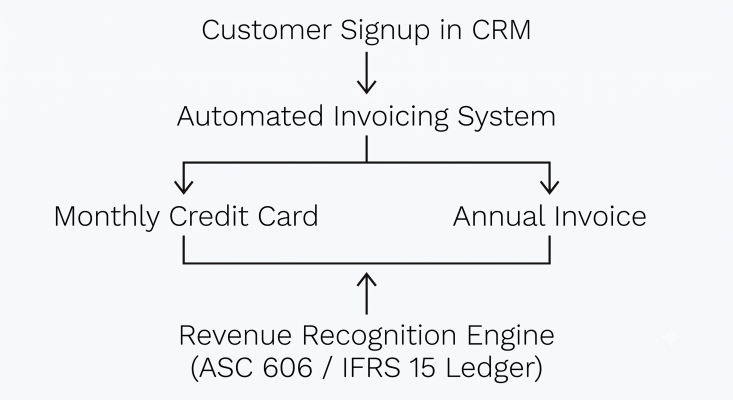
- Deploy Revenue Recognition Software: This action may have implications for a business’s revenue management. The integration capabilities of these tools connect accounting applications with CRM and ERP systems, influencing the development of recognition models and compliance with ASC 606.
- Standardize Contract Terms: One of the major challenges for businesses is creating standardized contract templates that clearly define the duration of the subscription, renewal policies, level of service, processing of information, and termination policies.
- Automate Recurring Invoicing: Automated recurring invoicing represents a method businesses might employ concerning efficiency. Such systems allow for the setting of recurring payments, such as monthly credit card charges or an annual subscription fee, which falls due at the end of the subscription period.
- Establish Dunning Management: Other important features of an invoicing system include dunning management and the ability to send out escalation emails to collect the outstanding balance.
- Consider third-party sellers: If your business allows third-party sellers to offer your products and services, then you are not the sole seller of record. In this case, you will be relieved of the burden of many vital processes such as tax registration, filing, payment methods, chargebacks, and refunds. In contrast, a Merchant of Record takes over all of these tasks.
Offer a discount on the annual subscription fee if customers agree to pay upfront for the entire year (e.g., 10% to 15% off). This may influence customer decisions regarding an annual commitment and relate to the management of cash flow during the migration.
Operating as a full-service Merchant of Record, PayPro Global manages the legal sale of your SaaS or software products. It takes away all the financial burdens that are related to cross-border trade by arranging for VAT, GST, sales tax, chargebacks, and recurring billing components to be in place where needed – thus eliminating the need to put up or manage a global payment infrastructure.
FREE SaaS Transition Checklist: From Perpetual Licenses to SaaS Subscriptions
Streamline your move to a SaaS subscription model using our step-by-step operational strategy.
-
A list of financial metrics to track during your pivot
-
Essential steps for automated recurring billing setup
-
Actionable workflows for reorganizing customer success teams
-
Troubleshooting tips for legacy data migration
Reorganize Internal Teams
In order to achieve a company’s long-term profitability, a SaaS business model requires high-quality customer retention as the initial sale does not cover the cost of customer acquisition. In traditional software sales, the workload decreases after the delivery of the license key, while in the case of subscription-based products, to secure renewals the focus should be put on ongoing engagement.
If you want to transform your company, it is a process that involves changing the way the company is put together and in particular, the way in which the sales team is organized.
Customer support teams should be transformed into customer success groups that include a section dedicated to monitoring the use of the software and helping users to use the appropriate features. In the same time period, product engineering should be changed such that it focuses its efforts on creating new releases every 18 months instead of the usual five-year projects.
| Team / Function | Traditional Model | SaaS Model |
| Sales | Focuses on One-Time License Sales | Focuses on Initial Deals + Upsells |
| Engineering | Works on 18-Month Release Cycles | Ships Weekly/Monthly Platform Updates |
| Support / Success | Responds Only to Inbound Bugs | Proactively Monitors Account Health & Usage |
Data management company Rubrik was in the process of migrating its CDM product sales model to a subscription model over a period of time. In its S-1 filing, Rubrik stated that maintenance revenue from legacy perpetual licenses decreased by $37.5 million (49%) in the fiscal year 2024 as customers increased their usage of the subscription model, which required the sales and marketing teams to be aligned towards the long term success of the account.
Healthy subscription software companies have a gross revenue retention rate of more than 90%, which indicates that there is enough value created by the software for existing customers.
FREE SaaS Transition Checklist: From Perpetual Licenses to SaaS Subscriptions
Streamline your move to a SaaS subscription model using our step-by-step operational strategy.
-
A list of financial metrics to track during your pivot
-
Essential steps for automated recurring billing setup
-
Actionable workflows for reorganizing customer success teams
-
Troubleshooting tips for legacy data migration
Migrate Legacy Customers and Infrastructure
When migrating existing users from applications installed locally to a cloud environment provided by a vendor, many factors have to be considered to avoid system crash and loss of critical information. One of the challenges is to put in place safe tools or methods to transfer the old databases to the cloud, and at the same time keep good records of users and their permissions. This includes implementing strict security policies, creating clear data retention policies, and putting in place Service Level Agreements (SLAs) related to application availability and response times to incidents.
To gain the cooperation of legacy users, it is important to offer immediate benefits such as early access to new features or lower subscription rates, to encourage them to accept the new terms. It is also necessary to put in place operating procedures that are clear and efficient, so that the increased volume of account data is well-organized.
On-Premises Deployment:
Customer Infrastructure ← Receives Binaries ← Software Supplier
SaaS Deployment:
Customer Access → Remote Web/API Access → Supplier Hosted Cloud
Troubleshooting common transition challenges
| Challenge | Cause | Solution |
| Initial Revenue Dip | Moving away from making large upfront payments and instead making smaller payments over a longer period of time. | Encourage people to subscribe for an annual subscription in order to collect their cash quickly. |
| Customer Resistance | Buyers used a software budget that includes capital expenditure (CapEx). | Explain included hosting, as well as maintenance, updates, and the fact that this is an initial investment that is lower. |
| Vendor Lock-In Concerns | Customers worry about losing access to their data if they decide to cancel their subscription. | Consider adding a clear exit tool that allows users to export their data at any time. |
| Tax Exposure | When applying for recurring cross-border subscriptions, there are registration and transactional details to consider that one-time license sales did not involve. | Clearly define the registration process in each of the markets in which you are operating and make a decision early whether to build the capability in-house, purchase it, or pass it over to a different company. |
In order to get information on how people are using a product, usage analytics tools should be employed. This process provides information regarding feature non-usage, which assists in identifying accounts with potential for early agreement termination, allowing for timely team involvement.
Conclusion
To optimize profits, a SaaS company should consider integrating its pricing policies, financial reporting, and operational processes around recurring revenue. It is crucial to consider cash flow during the transition period at the start of the transition as the company’s income is spread over the duration of the contract. These steps relate to the generation of recurring revenue streams, customer retention levels, and product quality within software companies.
Ready to get started?
We’ve been where you are. Let’s share our 19 years of experience and make your global dreams a reality.

FAQ
-
A perpetual license allows for the ongoing use of software based on an initial, one-time payment. Typically, such a license is offered in combination with an optional annual maintenance fee for updates and support. In contrast, a SaaS subscription gives the user access to a hosted service as long as the subscription is active, which is usually for a set period of time, such as monthly or annually.
-
Adopting a SaaS model typically results in Annual Recurring Revenue (ARR) exhibiting greater consistency, which can correlate with company valuation, in contrast to revenue from single-transaction sales. SaaS enables providers to implement upgrades and gather usage data, which can affect customer retention.
-
The finance and accounting departments of a company keep an eye on the cash flow position by monitoring cash receipt patterns with recognized revenue according to ASC 606. Companies typically seek prompt payment and establish credit lines for operational coverage, especially when recurring revenues are available.
-
To encourage people to move to the cloud, provide exclusive cloud-only features, instant access to the latest features, and discounted transition pricing. Stress that removing local hosting, maintenance, and IT expenditures from consideration is associated with a reclassification of customer costs from CapEx to OpEx.
-
The key metrics are Annual Recurring Revenue (ARR), Monthly Recurring Revenue (MRR), Customer Acquisition Cost (CAC), and Customer Lifetime Value (LTV). Revenue retention rates and cash billings are also important indicators of health and short-term liquidity during the pivot.
-
Cloud-hosted software is a delivery model in which software is hosted on the cloud and the customer may still be responsible for the management, maintenance, or updating of the application instance. In SaaS models, the supplier bears all the costs of hosting, maintenance, security, and updates of the entire application stack as a fully managed service accessed via web or API.
-
Sales commission adjustments involve a transition from compensation tied to large, single transactions to compensation structures that emphasize retention, renewals, and expansion. Engineering teams also change, from the traditional 18-month product release cycle to one of continuous integration and deployment, which involves releasing smaller upgrades to the cloud platform gradually.


 English
  Español
  Português
  Português do Brasil
  Français
  Italiano
  Deutsch
  Nederlands
  Polski
  Română
  Українська
  简体中文
简体中文  日本語
日本語  한국어
한국어