

How to Improve Your SaaS Activation Rate for Your Business
To increase the SaaS Activation Rate of your SaaS business, it is a functional responsibility to eliminate all the friction elements in the onboarding funnel and take users to the stage where the first value is provided. Activation rate defines whether new users are using the core functionality of the product, which in this case is the bridge between customer acquisition and retention. A common observation among software companies is a high number of free trial registrations and a comparatively lower rate of transition to paid versions, often due to users signing up but not proceeding with product usage or significant actions.
This guide outlines a structured approach for identifying points of exit, addressing user experience, and implementing product adjustments.
The application of this approach can provide a structure that relates to aspects of user experience and the scope of early retention metrics.

Concept snapshot
-

Category: SaaS Product Management
-

Used By: Product-Led B2B SaaS
-

Primary Purpose: Tracking early user utility
-

Related Concepts: TTV, SaaS Activation Rate Calculator, SaaS metrics & KPI, Customer cohorts, Onboarding funnel
-

Stage in Growth: Initial Product Launch
Define Your Core Value Milestone
To understand how to measure SaaS activation rate properly, you need to identify the activities or a series of activities that are relevant to the retention of a customer in the long term. It is necessary to determine the “ah-ha” moment of the product – that is, the point of understanding the purpose of the application – and to remove all the barriers from the way of that path. Such an approach increases the chance of activation and leads to increased conversions, longer subscriptions and more satisfied customers. This process takes ambiguous user actions and turns them into clear items that the development team can monitor.
When you are planning to engage the resources of your engineering department in the process of redesigning the user interface of your application, the first thing you need is to determine if your application requires a high or low level of introduction.
You can get an idea of the effectiveness of your product by answering these three questions to yourself: Is your software simple or does it have complicated features? Is the transfer of customer data from the legacy system occurring prior to the new system’s full operational capability? What is the value of the contract?
In applications with low contract value, an automated, non-interactive path and one that is self-paced is enough, while in enterprise saas applications, a mixed approach of in-app guides and engineering support is needed.
The implementation of certain strategies can influence user retention, with a potential for higher drop-off rates linked to insufficient user instruction or demanding access policies.
The activation step is not simply having an account or logging in. It is the particular action where the user takes the very first time some practical benefit from the software.
Set the event to take place within the user’s first session or a maximum of 48 hours.When the requirements for this stage involve a limited number of factors, such as the conclusion of a billing cycle, the observed conversion rate is often characterized by a lower magnitude.
In 2020, Loom had on its list that users who have recorded and shared at least one video during the 48-hour time period have a 60% higher retention rate than those who just moved around the interface.
Free SaaS Activation Rate Optimization Checklist
Audit your user path and systematically increase your saas activation rate with this checklist.
-

A detailed onboarding friction audit
-
Critical tracking event setup protocols
-
Tailored behavioral email templates
-
and more!
Establish Your Performance Baseline
When you have defined your milestone, you should also know your baseline performance and compare it with other products on the market. This approach provides a numerical background for further testing and software modifications. However, this parameter has to be calculated for a certain time period, or away the effect of seasonal fluctuations.
SaaS Activation Rate = (Users Who Complete Milestone/Total New Sign-ups) x 100
According to the open source product growth benchmarks published by OpenView Venture Partners, the average SaaS activation rate benchmark is 30-40% for product-led growth companies. Top-performing software products achieve rates above 50%, while poorly-designed products drop below 15%. A reduction in activations below this range may prompt consideration for adjustments to the onboarding process.
|
Performance Tier |
Activation Rate Range |
Customer Attrition Implication |
|
High Performance |
50% – 65% |
High trial-to-paid conversion; efficient ad spend |
|
Industry Average |
30% – 40% |
Moderate conversion; normal funnel drop-off |
|
Underperforming |
Below 20% |
High acquisition costs; product interface confusion |
To gather this information, you can embed SaaS analytics tools like Mixpanel or Amplitude app into your codebase to record user events. Analysis may involve forming sign-up groups based on weekly or monthly SaaS cohorts to monitor activation rate progression following user interface modifications. A popular problem is the inclusion of different sources of SaaS acquisition channels with a mix of populations that leads to bias in the calculation of the baseline, which can be avoided by dividing the baseline calculation according to the acquisition channel.
Eliminate any test accounts created by your own development team and marketing people from the list to get the real representation of customer behavior.
Free SaaS Activation Rate Optimization Checklist
Audit your user path and systematically increase your saas activation rate with this checklist.
-
A detailed onboarding friction audit
-
Critical tracking event setup protocols
-
Tailored behavioral email templates
-
and more!
Streamline and Personalize the Onboarding Flow
To speed up the time it takes to reach the stage where the user is, it is necessary to remove unnecessary fields, configurations and steps from the registration process. Strategic SaaS user onboarding, personalization and data-driven optimization can help turn an average sign-up into one with sustained engagement. It is better to consider implementing SaaS customer segmentation very early in the user life cycle, as it allows showing different features of the role to only those users who need them. This approach tends to correlate with decreased time and effort in completing account creation.
Use active controls, such as progress bars, checklist boxes, and contextual tools, to guide users of the SaaS UI UX design around in a sequence. Visual design considerations may involve prioritizing the action button and directing attention towards it by reducing the prominence of other navigational elements.
In 2021, the design team at the email marketing platform Mailchimp redesigned their registration process by removing secondary profile questions and moving them to a later stage. Observations after this change indicated registration times of under 5 minutes, accompanied by a 12% alteration in new user numbers. The result confirmed that users do want to provide their profile details after they have used the product.
The presence of a barrier during app usage may lead to users halting their engagement with the process. To avoid this, prepare the stage with fictitious data or templates with content already in them, so the user will be working with a lived-in environment as opposed to a blank one.
Free SaaS Activation Rate Optimization Checklist
Audit your user path and systematically increase your saas activation rate with this checklist.
-
A detailed onboarding friction audit
-
Critical tracking event setup protocols
-
Tailored behavioral email templates
-
and more!
Implement Behavioral Messaging Nudges
In order to win back customers who have left the site too early to complete the activation process, it is necessary to carry out a marketing automation communication across email and within the app. Message delivery should relate to a user’s inactivity, distinct from a fixed calendar schedule. This approach helps to create a message that corresponds to what the user has done or has not done in the app.
A common practice involves sending an email to a potential customer 24 hours after registration when no significant system activity has been recorded. The content of the email should include a button that leads to the page where the user left off. Data within the B2B SaaS industry indicates that behavior-based notifications correspond with open rates four times the average of general email blasts.
Time-efficient video clips should be incorporated in these types of messages to showcase how to carry out the actions being offered. However, it is relevant to consider the recipient’s activity or subscriber status when sending emails, rather than solely relying on calendar-based generalization. A concentration of notices in a brief period has the potential to correlate with users’ decisions regarding account removal or account transfer. To avoid this, set up a rule in your marketing platform to turn off messages so they are only sent to an email address once every 24 hours.
|
Notification Channel |
Ideal Timing |
Primary Objective |
|
In-App Tooltip |
Immediate (First session) |
Guide the user to click the core feature button |
|
Behavioral Email |
24 Hours post-signup |
Re-engage inactive users with a direct setup link |
|
SMS / Push |
72 Hours post-signup |
Offer technical support or documentation access |
Free SaaS Activation Rate Optimization Checklist
Audit your user path and systematically increase your saas activation rate with this checklist.
-
A detailed onboarding friction audit
-
Critical tracking event setup protocols
-
Tailored behavioral email templates
-
and more!
Utilize A/B Testing to Refine Touchpoints
To find the particular areas of the funnel where users leave, you need to prepare such an analysis at least once every week. It is necessary to be guided by data when carrying out experimental activities for the further enhancement of activation. A/B testing or onboarding experiments should be performed regularly in order to know what works well, and not what one thinks should work. This influences the need for estimation within the engineering process.
Minor adjustments, such as modifying button text or step order, can provide information if appropriately evaluated. Establishing a culture of continuous testing and refinement may correlate with changes in performance over time.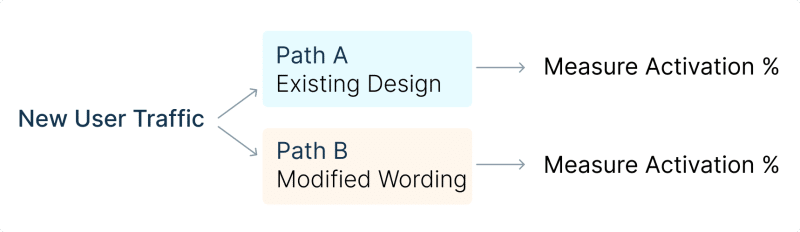
The experiment should be carried out till a point of statistical significance is reached to confirm if the new design changes the Saas Activation Rate.
If the reasons for user abandonment of a step are not logical, obtaining user opinions in SaaS applications is an important thing to consider; you may watch previous user sessions or prepare quick text surveys at the end of the session to take away the voices of the customers.
With these technical aspects in mind, it is necessary to modify the development process and go with an agile approach to make changes to the user experience gradually.
Do not test more than one variable at a time, for example, the color of the button and the text of the header, but rather concentrate on one at a time. Testing multiple changes simultaneously can obscure the individual impact of each change.
Conclusion
Improving your product Activation Rates requires a clear definition of value, a basis for measurement, and a smooth onboarding process. Behavioral thresholds, personalization, and controlled A/B testing can be applied to address factors that act as impediments to software usage. The oversight of these stages during the full duration relates to SaaS retention over time and the progression of the business in the SaaS model.
FAQ
-
The average activation rate for a product-led B2B SaaS company is between 30% and 40%, but the top performers can even reach 50%. This is a general guideline for all SaaS companies, but the figure can be quite flexible for different industries. For instance, high-friction financial products tend to have even lower activation rates, while very interactive AI tools can achieve even higher activation rates than 55%.
-
The “aha moment” refers to an emotional or cognitive occurrence where a user recognizes the utility of the software. In contrast, user activation is the actual performance of the action specified in the aha moment, which confirms that the customer has utilized the product effectively.
-
The core configuration of a retention rate strategy should be based on a single, major event that is the most significant predictor of whether a user will keep subscribing in the long run. However, as your applications increase in number, you may also consider monitoring additional metrics or using an activations model that weights different user types according to a classification scheme.
-
An adjustment in the activation rate can influence the timeframe for recouping the Cost of Customer Acquisition (CAC) by impacting the investment in attracting users who do not interact with the product. Product usage and perceived utility among registered accounts tend to correlate with trial-to-purchase conversion rates and may affect the profitability of advertising investments.
-
User activation is an important benchmark for any SaaS company as it reflects the number of new customers who have completed the necessary steps to start using the product during their initial setup phase or first 48 hours. Product adoption, on the other hand, focuses on the long-term usage of the product, considering whether users are actually using all the features available.
-
The ideal time-to-value period for a product is dependent on the complexity of the product, but for simple applications, users should be able to complete their task in just one session or less than 5 minutes. If your system requires an integration with another application or large amounts of data, it is important to complete the integration within a week.
-
Automated emails serve a function in the retrieval of inactive accounts. In contrast, the direct activation or engagement of users often occurs within the application, as specific characteristics of the app interface design present challenges that may be addressed via redesign. Depending too much on outside email communications does not enable resolving all the practical issues related to how the app’s features are laid out, the navigation clarity, or the presence of a ‘no content yet’ hurdle in the space where the work is being done.
Ready to get started?
We’ve been where you are. Let’s share our 19 years of experience and make your global dreams a reality.


 English
  Español
  Português
  Português do Brasil
  Français
  Italiano
  Deutsch
  Nederlands
  Polski
  Română
  Українська
  简体中文
简体中文  日本語
日本語  한국어
한국어